
Columbia Men's Silver Ridge Utility Pants
A documented current style for practicing separation of composition, movement features and ratings.
Consider: Do not apply its current specification to every Silver Ridge title.
Check on Amazonfoundations
“Quick dry, four-way stretch, weather resistant” sounds informative until you try to compare it with a pair described as “technical performance fabric.” Product language mixes ingredients, construction, measured ratings and broad promotional terms. Reading those categories separately helps you spot both useful evidence and unanswered questions. You do not need a textile qualification; you need to know what each label actually describes and what it leaves unresolved.
Three places to start
As an Amazon Associate I earn from qualifying purchases. Purchases take place on Amazon.
A documented current style for practicing separation of composition, movement features and ratings.
Consider: Do not apply its current specification to every Silver Ridge title.
Check on Amazon
A lower-cost comparison that encourages checking actual detail rather than buying by feature vocabulary.
Consider: Unknown specifications remain unknown; do not borrow them from another ATG model.
Check on Amazon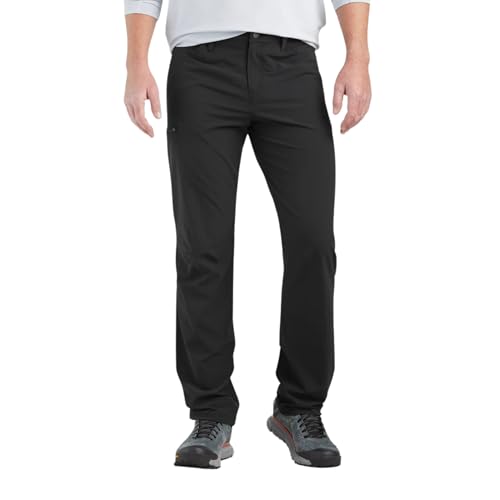
A model with manufacturer fabric and waist information to compare against the label-reading checklist.
Consider: A documented rating still does not guarantee overall comfort or fit.
Check on AmazonEditorial selections from the products considered for this guide; not hands-on test awards. Budget and premium describe positioning, not a guaranteed current price.
Start with ingredients: nylon, polyester, cotton, wool and elastic fibers. Next identify construction words such as woven, knit, ripstop, lined or double weave. Then separate fit descriptions and performance language. This simple sorting prevents a title full of familiar technical words from seeming more precise than it is.
“Stretch nylon” combines an ingredient with a behavior claim. “Ripstop polyester” combines an ingredient with a weave. “Water-resistant softshell” combines a garment-construction category with a broad claim about water. These phrases can be useful, but they are not interchangeable descriptions of the same property.
Keep a short list of the questions that remain. You might still need the actual inseam, whether the waist stretches, which pockets close securely or how the garment should dry. A good product label helps resolve a purchase decision rather than merely increasing the number of features you can repeat.
Composition tells you what the textile contains. It does not independently tell you how heavy, tightly woven or stretchy the finished trouser feels. Two garments with similar percentages can differ in fabric weight, finishing, pattern and reinforcement.
Columbia's current Men's Silver Ridge Utility Pant, style 2012951, is documented as recycled polyester. Outdoor Research describes the Men's Ferrosi Pant with a nylon-and-spandex composition. Those facts distinguish the examples, but they do not justify an unsupported numerical ranking for breathability, abrasion resistance or drying.
Read panel and lining information separately when provided. A main-fabric composition may not include reinforcement, pocket bags or elastic at the waist. On a mixed-material garment, the care requirement can depend on the combination rather than whichever fabric occupies the largest visible area.
A recycled-content statement refers to material sourcing, not an automatic improvement in fit or performance. Check whether the claim refers to the whole fabric, one component or a stated percentage. Do not convert a general recycled description into a numerical percentage that the manufacturer has not supplied.
Likewise, a statement about a finish should stay attached to the exact model and terminology. PFAS-free, PFC-free and other chemical-related language should not be casually rewritten into broader health or environmental guarantees. Product generations can change, and the same family name may appear across different descriptions.
The practical question is whether the statement addresses a requirement you actually have. If a particular material or finish criterion is essential, choose a clearly documented version. A vague title is not enough to resolve a strict purchasing constraint.
A manufacturer may describe mechanical stretch in a fabric without listing elastane or spandex in the composition. Pattern features also affect movement: a gusset adds a shaped panel, while articulated knees change how the leg bends. These are different mechanisms and should not be counted as duplicate proof of the same thing.
Four-way and two-way labels describe directions of stretch, but they do not establish an identical amount of stretch across brands. Without comparable testing details, avoid treating the terms as a universal numerical standard. The finished garment still needs to fit your body and the movements you make.
Pay attention to the waistband separately. Columbia's Women's Leslie Falls Pants II uses stretch fabric alongside a structured waist. That example shows why a stretchy leg does not prove pull-on entry or an elastic waist. Read the closure description instead of extending the fabric claim to every part of the garment.
A DWR finish is intended to encourage water to bead on a surface. That surface behavior is different from a waterproof barrier and sealed construction. Ordinary hiking pants may carry water-resistant descriptions while remaining unsuitable as your only rain layer in sustained wet conditions.
Do not assign a waterproof rating unless the exact garment has a supported rating and the relevant construction is documented. A photo of droplets on fabric does not establish seam performance, and a generic “weather resistant” phrase does not settle the question.
Care matters because surface repellency can change with dirt, oils and wear. The DWR care guide explains cleaning and compatible treatment without promising that an ordinary woven trouser can be converted into a waterproof shell.
UPF describes how much ultraviolet radiation a fabric transmits under the relevant testing conditions. A specific manufacturer rating is more informative than a general sun-protection phrase. It should nevertheless remain attached to the documented garment rather than an entire brand or fiber category.
Coverage and garment condition also matter in use. A rating does not describe the skin left uncovered above a rolled cuff, and it should not become a promise that wearing the trousers guarantees a health outcome. Do not infer a numerical UPF from a dark color or a dense-looking photograph.
If the listing and manufacturer differ, verify the version before repeating either number. A reliable comparison can simply mark a rating as not confirmed for that selected item. Absence of a documented number is an information gap, not permission to invent a reassuring one.
A stated garment weight can help compare pack contents, provided you know which model and size it represents. A larger size or an alternate inseam can weigh differently. Comparing a manufacturer's reference sample with another listing's shipping weight is not a meaningful garment comparison.
Shipping weight may include packaging and should not be relabeled as trouser weight. If only a general lightweight claim is available, keep the description qualitative and attributed. Do not calculate an exact weight from fabric percentages or from how thin the product image appears.
For an owned pair, you can weigh the clean, dry garment with its included belt and any detachable legs arranged consistently. That produces a measurement for your own packing plan. It does not become a universal specification for all sizes of the model.
Regular, standard, active, relaxed and slim are brand- or model-specific descriptions. They do not provide a universal conversion between products. A relaxed cut in one range may still feel restrictive in a particular area if the rise or thigh shape does not match you.
Use the chart to identify whether it gives body measurements or finished-garment measurements. Then check the inseam separately. The online listing guide covers the final selection process, while the movement guide turns those numbers into a practical fitting session.
A model can have excellent documentation and still be unsuitable for you. Labels narrow uncertainty; they do not replace the experience of sitting, stepping and wearing your usual pack with the garment.
Look for washing, drying, ironing and treatment restrictions before deciding that a garment suits your routine. A material name alone is not enough to choose a temperature or drying cycle. Finishes, elastics and mixed panels can change the instructions.
If a product page offers generic care text but the garment label later differs, pause and obtain model-specific clarification. Never assume every pant in a brand can be washed with the same recipe. Preserve a photograph of the actual label for future reference while it is readable.
The most useful final note contains verified facts and a few honest unknowns. You should be able to explain why the fabric, cut and care fit your needs without converting promotional language into invented test results. Browse a relevant collection only after deciding which of those details truly matter for your next purchase.
| Visible label | Useful follow-up | Conclusion to avoid |
|---|---|---|
| Recycled polyester | Does the exact model name the proportion and any different panels? | Assuming recycled content makes the garment dry faster. |
| Elastic waist | Is the whole waist elastic, only the rear, or just a small insert? | Assuming every size fits a broad range of bodies. |
| Quick dry | Is there a comparable test or only a qualitative description? | Promising the complete garment will dry by morning. |
This translation keeps the label connected to a decision. If a follow-up remains unanswered but is essential to your needs, seek better information rather than filling the gap with an attractive assumption.
No. Ripstop describes a reinforcing weave pattern, not immunity to cuts, abrasion or tears. The exact fabric and the location and type of damage still matter.
A manufacturer may describe mechanical stretch, and pattern features can add movement room. Confirm the exact claim and fit the garment rather than judging mobility from fiber percentages alone.
Not necessarily. Shipping or package weight can include other materials. Use a clearly identified garment weight with a reference size, or measure your own dry pair for personal packing.
Read technical labels as a set of separate clues. Composition, weave, fit, ratings and care each answer a different question, and no single phrase summarizes the entire garment. Keep claims attached to their exact model, avoid filling in absent measurements, and use the resulting information to guide a real fitting and ownership decision. A short, accurate specification list is more helpful than a long list of confident-sounding assumptions. The aim is to understand what you are buying well enough to recognize both its usefulness and its limits.