
Columbia Men's Silver Ridge Utility Pants
A documented comfort-stretch and gusset combination for understanding pattern versus fiber.
Consider: Its fabric claim does not predict an individual fit.
Check on Amazonconstruction
Two pairs can carry the word stretch on their labels and feel very different on a high step. One relies on fabric extension, another gives the body more room through a shaped pattern, and a third combines both approaches. Understanding those mechanisms helps explain why a lower stretch percentage can sometimes feel less restrictive, and why an elastic-rich fabric cannot compensate for every mismatch in rise or leg shape.
Three places to start
As an Amazon Associate I earn from qualifying purchases. Purchases take place on Amazon.
A documented comfort-stretch and gusset combination for understanding pattern versus fiber.
Consider: Its fabric claim does not predict an individual fit.
Check on Amazon
A lower-priced listed utility option to put through the same movement checks.
Consider: Do not infer gussets or stretch percentages from the category title.
Check on Amazon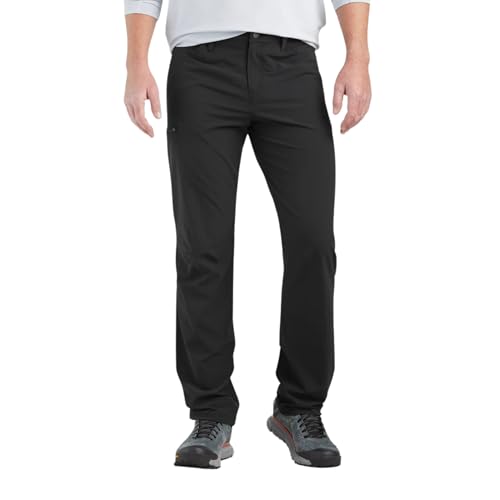
A documented higher-elastic-content fabric offers a different movement approach.
Consider: More elastic fiber is not proof of better fit or durability.
Check on AmazonEditorial selections from the products considered for this guide; not hands-on test awards. Budget and premium describe positioning, not a guaranteed current price.
Raise a knee while watching the front thigh, crotch and back waistband. The movement asks the garment to provide length over the bent joint and room around the hip. Fabric can extend, the cut can provide spare room, shaped panels can direct that room, or the trousers can simply pull upward elsewhere. The last response is often what makes a waistband dip or a cuff climb.
That observation is more useful than looking at the elastane percentage first. If the seat pulls down and the front crotch presses, the rise or shape may be poorly matched. If the leg feels fine except at one horizontal seam, a structured feature may be limiting otherwise flexible fabric. If the entire thigh is tight while standing, the issue is not confined to the knee.
Use a stable low step and ordinary comfortable movements. This is a fitting exercise, not a test of your flexibility or athletic ability. The aim is to discover which part of the garment starts resisting first. Once you can name that location, product specifications become more helpful because you know what problem you are trying to solve.
Elastane and spandex are names used for elastic fiber content in garment descriptions. A small amount can contribute to stretch, but the finished fabric's behavior also depends on yarns, weave or knit, density, finishing and how the panels are cut. Percentages alone do not tell you the force required to extend a fabric or how it behaves after repeated wear.
The referenced men's Ferrosi Pant is described by Outdoor Research with a nylon blend containing fourteen percent spandex. Columbia's current Women's Leslie Falls Pants II lists six percent elastane in a nylon blend. Those facts identify different compositions; they do not create a valid fourteen-versus-six mobility score. The waistband, pattern and fit may matter more to an individual wearer than that numerical difference.
Also distinguish stretchy fabric from a stretchy waist. Columbia describes a structured, non-stretch waistband on the current Leslie Falls Pants II even though its main fabric contains elastane. That is a useful warning against reading one material percentage as a whole-garment promise. Check each component that touches a pressure-sensitive or movement-heavy area.
A woven fabric can gain some movement from its construction rather than a listed elastic fiber. Manufacturers may describe this as mechanical or comfort stretch. The exact range and direction should come from the model's documentation, not from an assumption that all polyester or nylon behaves the same way.
Columbia's current Men's Silver Ridge Utility Pants list one hundred percent recycled polyester together with two-way comfort stretch. This is an example of why zero listed elastane does not mean a garment has no capacity to yield. It does not establish that the model stretches as far as a different fabric, or that its movement is equally easy in every direction.
Two-way and four-way language can be helpful when a manufacturer defines it, but do not use the terms as an automatic quality ladder. The direction in which a panel needs to move depends on its placement. A well-cut garment with modest extension can feel excellent, while a more elastic fabric in a restrictive cut may still pull. Evaluate the claim alongside the full pattern and your own movement check.
A crotch gusset is an additional panel arrangement in an area where several seams otherwise meet. Its geometry can provide room and alter how stress is distributed when the legs move apart. The presence of a gusset is useful information, but the word does not tell you its dimensions, shape or how that pattern suits your body.
Look for where the panel begins and ends, and feel the seam junctions inside. A gusset can coexist with an uncomfortable seam allowance or a rise that is too short. Conversely, a garment without an advertised gusset may provide enough movement through a different cut. Do not reject every un-gusseted pant or assume every gusseted one will solve crotch pressure.
Columbia lists a gusset on the current Silver Ridge Utility models. prAna describes a ventilated gusset on the current Stretch Zion Relaxed and Standard. Ventilation is an additional design detail, not a synonym for the gusset itself. Confirm the exact version before transferring that feature to an older Zion listing or another product that happens to share the family name.
Articulated knees use pattern shaping, such as seams or darts, to build curvature into the leg. That can reduce the need for all the required movement to come from fabric extension. The important question is whether the shaped region meets your knee at the point where you bend.
Inseam and body proportions influence that match. A pair with a long lower leg can have knee shaping that sits too low even if you shorten the hem. A shorter inseam option may help, but only if the manufacturer changes the relevant pattern placement rather than simply trimming length. Ask about the specific model if that distinction matters to your fit.
The current Men's Paramount Pants and Paramount Convertible from The North Face list articulated knees. The current Paramount Active instead describes knee darts alongside a crotch gusset. These are related approaches to shaping, but the models also differ in fit and fabric. Do not attribute the feel of one product entirely to its knee feature while ignoring the rest of its construction.
If the trousers feel tight across the thigh before you move, begin with more suitable circumference and shape. Additional stretch may make the garment tolerable while preserving constant tension, which is not necessarily the comfort you wanted. Try another cut before paying for a larger stretch claim.
If standing fit is comfortable but the crotch pulls on a high step, compare rise, gusset shape and seat room. If restriction concentrates over the knee, inspect articulation placement and the amount of fabric available above and below it. If the waistband dips, the garment may be borrowing length from the waist because another area cannot accommodate the bend.
Change one variable at a time when possible. Compare adjacent fits within a model or a similar-size alternative, then repeat the same movements. A label cannot tell you whether a particular body-to-pattern relationship works. The value of understanding construction is that it makes the comparison more deliberate and reduces the temptation to solve every problem by buying the most elastic fabric available.
A useful comparison note identifies both the movement and its consequence: the knee bends comfortably but the rear waist lowers, or the side step is easy while sitting creates front-thigh pressure. This prevents a single successful movement from ending the fitting too early. You are looking for a pattern that handles your normal range consistently, rather than one that excels at a pose you seldom use outside.
| Construction detail | What it changes | What remains to check |
|---|---|---|
| Fabric stretch | How material extends under movement | Fit, extension direction and component tension |
| Gusset | Panel geometry at a seam junction | Rise, panel position and seam comfort |
| Articulated knee | Shape around the bending joint | Alignment with your knee and usable leg length |
A fabric that extends easily is not automatically more abrasion resistant, more breathable or quicker to dry. Those properties need their own evidence and depend on construction. Likewise, a reinforced knee can change wear resistance in one location while also changing flexibility. Decide which tradeoff matters on your route instead of treating one feature as proof of complete performance.
A useful technical example is Mountain Hardwear's current Chockstone Alpine Light, described with four-way stretch and articulated knees. The manufacturer lists a specific nylon-elastane double weave. Those details explain the intended movement approach, but they do not establish superiority over every lighter trail pant, and its model name is not a comparative weight test.
Try the garment with the layers and pack you intend to use, then repeat the movement assessment with a light normal pocket load. Underlayers and hard objects can change the result. A pair that works alone may need more ease in a layered system. Choose enough movement for your actual use without turning stretch percentage into a contest divorced from fit.
It can provide useful movement through pattern design, but it does not make fabric extension irrelevant. Some cuts work well with little stretch, while others combine both mechanisms. Evaluate the finished garment rather than assuming one feature replaces the other.
Yes. Body proportions and garment length affect alignment. Bend your knee and check whether the shaped area follows it comfortably. Hemming the trousers changes the bottom length but does not necessarily reposition an already misplaced knee panel.
No. Directional extension is only part of the design. The force needed to stretch, recovery, panel placement and available room all influence comfort. A suitably cut two-way design may work better for you than a tighter four-way alternative.
Read stretch, gusset and articulation as three separate pieces of information. Fabric extension allows material to yield; panel geometry supplies room; knee shaping places that room around a joint. The strongest choice is the combination that lets you step, sit and bend without borrowing uncomfortable tension from another area. Use named specifications to explain what you feel, not to override it. If a high stretch percentage comes with a poor rise or misplaced knees, keep looking for a pattern that suits your movement.