
Columbia Women's Leslie Falls II Stretch Pants
A documented option for comparing shaped knees, practical storage and a structured waist.
Consider: The waistband is not a pull-on design despite stretch in the fabric.
Check on Amazonfoundations
Write down your next three walks before looking at pants. A shaded neighborhood trail, a full day carrying lunch and layers, and an exposed overnight route may produce three different wish lists. The challenge is finding the overlap without purchasing for an imaginary expedition. This guide turns that overlap into a short selection process, beginning with your actual outing and ending with a pair you can evaluate at home.
Three places to start
As an Amazon Associate I earn from qualifying purchases. Purchases take place on Amazon.
A documented option for comparing shaped knees, practical storage and a structured waist.
Consider: The waistband is not a pull-on design despite stretch in the fabric.
Check on Amazon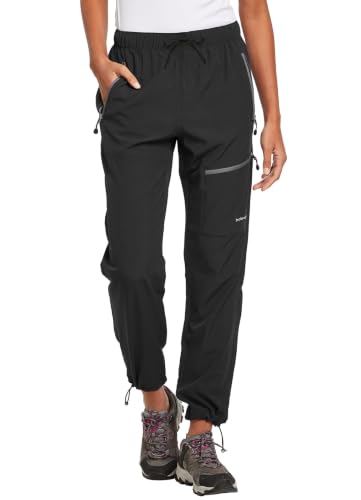
A lower-cost elastic-waist candidate when that closure meets your requirements.
Consider: The selected listing must supply your needed inseam and size.
Check on Amazon
A higher-priced candidate to fit alongside your footwear and pack before choosing.
Consider: Regular, short and plus listings must not be treated as interchangeable.
Check on AmazonEditorial selections from the products considered for this guide; not hands-on test awards. Budget and premium describe positioning, not a guaranteed current price.
First, note whether you expect mostly walking on maintained paths or frequent high steps and contact with rough ground. This is not a technical route grading exercise. It is a way to identify where your trousers are likely to bend, rub and carry objects. A description of your actual day is more valuable than an abstract promise of ruggedness.
Second, record the likely range of conditions, including stops. A steady uphill walk and a long lunch break make different demands. Consider whether another layer is already part of your plan and whether you need room beneath the trousers or space for a shell outside them.
Third, list what touches the waistband: perhaps a light daypack, a substantial hipbelt or no pack at all. Finally, list what you keep in pockets. Restrict that list to objects you truly need within reach. These four lines become a filter you can apply to every product description.
A lined pant is a specific choice, not a premium version of an unlined one. If you routinely become warm while climbing, permanently attached insulation gives you fewer adjustment options than an unlined pair and separate layers. If you want straightforward warmth for cool, short outings, that compromise may suit you.
Convertible trousers similarly solve a particular problem. Choose them when removing the lower legs is something you expect to do, and examine the resulting shorts length and zipper position. If changing coverage is rare, the additional hardware may offer little benefit. Roll-up cuffs are another approach, with different limits around calf bulk and footwear.
Do not put ordinary water-resistant pants and waterproof rain shells into one undifferentiated shortlist. A surface finish that encourages droplets to bead does not establish sealed seams or a waterproof barrier. The rain-layer guide explains when a separate shell belongs in the system.
Once you remove unsuitable construction types, choose two or three candidates. An enormous shortlist can hide basic differences because you start remembering advertising words instead of the reason each pair remains under consideration.
For one walker, the hard requirement is a short listed inseam. For another, it is a waistband that does not bunch beneath a pack. Use whichever factor has ruled out previous trousers. An attractive model that cannot meet that constraint should leave the shortlist early, even if its other features are appealing.
Columbia's Women's Leslie Falls Pants II illustrates why exact features matter. The manufacturer describes a structured waistband with stretch fabric in the garment. Someone who specifically needs a pull-on waist should not assume fabric stretch makes that construction equivalent to the Leslie Falls Pull-On model.
A BALEAF women's quick-dry hiking jogger listing offers a different starting point, with an elastic-waist description. That is useful evidence about its closure arrangement, but it does not prove the same rise, measurements or material as another BALEAF style. Compare the selected listing rather than treating the brand name as a specification.
Outdoor Research's Women's Ferrosi Pants are another option to evaluate when the selected inseam and size are suitable. The collection includes differing lengths and a separately named plus option. The existence of those listings does not mean every color is offered in every configuration. Your actual size remains the constraint.
Instead of asking which fiber is best, ask what you need the fabric to do. Are you trying to reduce packed bulk, gain movement over steps, tolerate repeated contact at the knees or manage washing between travel days? The answer determines what supporting details matter.
Fiber percentages describe ingredients, not the finished experience. Weave, fabric weight, finishing and pattern all influence a garment. A small amount of elastic fiber may be useful, but a percentage alone does not tell you how far the waistband stretches or how a thigh panel behaves under load.
Look for explicit model information and keep unknowns visible in your notes. If weight is absent, do not estimate it from a studio image. If water resistance appears only as an unqualified title phrase, do not elevate it into a quantified rain-performance claim. A model with less dramatic language and more useful measurements may be easier to choose confidently.
A pocket is helpful only if you can use it while wearing the rest of your kit. Mark where a hipbelt crosses the upper pockets and where a phone would sit on the thigh. Zippers can keep objects contained, but they also need enough clear space to operate.
Think about the contents when seated. A large phone may be comfortable while standing and press into the leg when you stop for lunch. A loose cargo pocket can move with every step if filled with dense objects. The answer might be a different pocket, a smaller load or moving the object into the pack.
Do not make pocket count the tie-breaker unless you have assigned a purpose to the additional compartments. Several inconvenient pockets are not necessarily better than a few accessible ones. The separate pocket-layout guide can help when storage is your main decision.
Begin without a pack. Fasten the trousers normally, sit, bend and take a comfortable high step. Watch for the waistband pulling down, the fly straining or the knees stopping movement. If the fabric is supposed to stretch, notice whether it recovers rather than relying on pulling the garment into place repeatedly.
Then add your usual shoes, belt and backpack. Repeat the movements. Hardware that seemed unobtrusive can become noticeable under a loaded hipbelt. The cuff may behave differently over boots than with socks alone. Empty and reload the pockets to separate a pattern problem from a carrying problem.
Take notes in plain language: “waist moves when stepping,” “phone inaccessible with pack” or “hem catches boot.” These notes are more useful than a vague impression that a pair feels technical. They also make a second fitting on another day easier to compare.
If two pairs meet your route and fitting needs, compare the features you would use repeatedly. An easier waist adjustment, a documented alternate inseam or a better-positioned security pocket may justify more expense to you. A feature that will remain unused has less practical value, regardless of its prominence in the description.
Budget and premium are relative positions in a comparison, not permanent labels for entire brands. Prices can change by size, color and seller. Check the exact offer before ordering and do not assume an unusually low price applies to the version pictured elsewhere on the page.
Care requirements belong in this comparison too. A trouser that needs a washing routine you cannot follow may be inconvenient despite an excellent fit. Save the relevant instructions alongside your shortlist; ownership continues long after the first walk.
Keep one line for each candidate and five fields: exact model, required size, required inseam, reason it fits the route, and unresolved question. Add a sixth field only if needed for a specific issue such as pack interference or a hem alteration. The goal is a decision, not an elaborate scoring system that assigns invented numbers to comfort.
Reject a candidate if an unresolved question concerns your hardest requirement. If the missing detail is optional, decide whether you can inspect it under the seller's actual return conditions. Read those conditions directly; this site does not take orders or handle returns.
Your finished shortlist should explain itself without marketing language. Browse the women's hiking-pants collection or men's collection, then use the evidence and fitting sequence above to choose the model that suits the walks on your calendar.
A rejected pair can teach you something concrete. Record whether the problem was a short rise, a narrow cuff or an awkward pocket rather than writing off the entire brand. That distinction helps when the manufacturer offers a different cut. It also prevents repeatedly ordering the same unsuitable configuration under another model name. If every candidate fails in the same area, return to your measurements or hardest requirement; the shortlist may need a different pattern category instead of a slightly larger size.
Start with the outings you do most often, then decide what layers you can add for less common conditions. A permanently lined pair may suit one season well without serving as your only trouser.
Use it as a starting clue, not a conversion rule. Compare your measurements with the exact hiking-pants chart and check inseam separately. Brands and model cuts can differ.
Consider whether the missing storage can move into your pack. Fit affects every step, while an unused extra pocket contributes little. Retain only the storage you can explain a need for.
Choose the trousers that survive your actual constraints. Begin with the route, narrow by the construction you need, and let a fitting session with shoes and pack settle the final choice. A modest pair that clears those checks can be more useful than an expensive model selected for unfamiliar features. Keep a record of the exact version and the reasons you chose it; that makes future replacements more reliable and helps you recognize when a different trip truly calls for a different setup.