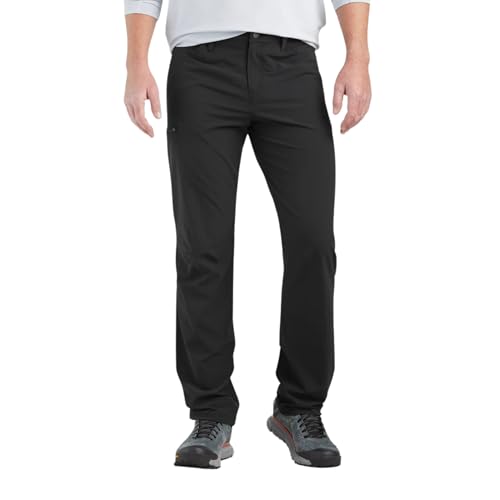
Outdoor Research Men's Ferrosi Pants
A stretch-oriented ordinary walking layer to compare under a separate rain shell.
Consider: Not waterproof; shell fit must be checked.
Check on Amazonweather
Water rolling off a new pair of trousers looks reassuring. It tells you something about the outer surface, but much less about what happens in prolonged rain, at a seam or where wet fabric is pressed against your leg. The first decision for a rainy hike is therefore not which ordinary pant beads water most impressively. It is whether the trip calls for ordinary walking pants, a waterproof overlayer, or both.
Three places to start
As an Amazon Associate I earn from qualifying purchases. Purchases take place on Amazon.
A stretch-oriented ordinary walking layer to compare under a separate rain shell.
Consider: Not waterproof; shell fit must be checked.
Check on Amazon
A lower-priced main pant with a manufacturer-described DWR finish.
Consider: Match plain Paramount generation; no rain-shell equivalence.
Check on Amazon
Technical softshell construction for a cooler-weather walking configuration.
Consider: More bulk under a shell and not waterproof itself.
Check on AmazonEditorial selections from the products considered for this guide; not hands-on test awards. Budget and premium describe positioning, not a guaranteed current price.
Water resistant describes a limited ability to resist water, not a guarantee that the inside will stay dry through every shower. A durable water-repellent finish, commonly shortened to DWR, changes how water behaves at the textile surface. It may help droplets roll away rather than immediately spreading into the outer fabric. That surface treatment is different from a waterproof membrane or coating within a rain garment.
Waterproof is also a claim that needs context. Check the actual product description for construction and seams, rather than treating a word in a marketplace title as complete evidence. A waterproof textile does not automatically explain how every zipper, opening and stitched seam is managed in the finished pants. A shell intended to go over another garment also needs enough usable room to perform that role.
Breathable is a third question. A garment can be described as waterproof and breathable without allowing the same airflow as an open woven hiking pant. Venting by opening a zip is different from moisture moving through the material itself. These distinctions explain why a shell can be valuable in rain yet less pleasant as an all-day walking layer in warm conditions.
REI's rainwear construction guide provides background on these terms. The practical lesson is to check what each layer actually does instead of expecting a single adjective to cover every weather need.
A short local walk with easy access back to shelter presents a different clothing decision from a remote route with repeated exposure and few opportunities to dry clothes. Consider duration, the expected amount of rain, air temperature and how much wet vegetation you will brush through. Avoid using the forecast icon alone: a small rain symbol gives little detail about the period when you will be walking.
Ordinary water-resistant pants can be convenient where a little temporary dampness is acceptable within the overall trip plan. They are usually simpler to move in than wearing two pairs together, and you avoid putting on a shell for every brief change in conditions. Their limitation is that you are accepting the possibility of wet fabric, rather than obtaining waterproof coverage.
A waterproof layer becomes a separate decision when that tradeoff does not suit the outing. Plan its use before leaving instead of waiting to see whether your main trousers happen to remain comfortable. A shell carried for contingencies must still be the correct size and accessible in your pack.
Do not turn this into a blanket rule that warm rain never matters or that a quick-dry label makes prolonged wet exposure trivial. The same pants can feel different when your pace slows, the wind rises or the day extends. Choose clothing alongside an appropriate route plan, not as a substitute for one.
Wet-out describes the outer textile taking on water instead of shedding it as readily. On a shell with a waterproof barrier, a wetted outer fabric does not by itself prove the barrier has developed a hole. Dirt, body oils and wear can affect the finish. Conversely, on an ordinary woven pant without waterproof construction, a refreshed DWR coating does not create a hidden rain barrier that was never there.
If you feel moisture inside a shell, observe where it is and what was happening. Dampness after hard climbing, moisture near an opening and a local leak at a damaged seam are different clues. They do not support the same fix. Simply applying more spray to the outside is not a diagnosis for every case.
The immediate buying implication is straightforward: do not reject or choose a garment solely on a beading photograph. A photograph shows one moment under unspecified conditions. It cannot establish long-duration waterproofness, how the garment ventilates or the condition of an older pair you already own.
Maintenance has its own limits. The finish terminology guide covers chemical claims, while product-specific care instructions determine compatible washing and reproofing. This article's role is to decide what kind of layer you need, not prescribe one treatment for every textile.
Try the shell over your intended hiking pants, with any additional layer you expect in cooler weather. Sit and raise a knee. Check whether the outer layer compresses a cargo pocket, catches on a belt buckle or pulls across the seat. A shell that closes easily over thin indoor trousers may not have enough space over the actual arrangement.
Then check the footwear interface. Some rain pants have short ankle zips; others open farther up the leg. The usable opening matters more than the presence of a zipper on the feature list. If the garment cannot clear your boots, you need to know that before trying to put it on in wet conditions.
Look at how the two hems interact. A long inner hem can hang below the shell, while tightly gathered cuffs can create a bulky band. If you use gaiters, rehearse that combination as well and follow the intended arrangement for the specific products. Avoid long loose cords and hardware that interferes with your stride.
Pocket access is often overlooked. Once the shell is on, the pockets of your ordinary pants may be inconvenient or unavailable. Decide where your phone and frequently used items will go before the weather changes. A good rain configuration supports the practical tasks of the walk as well as keeping its layers in place.
For the separate shell comparison, compare Marmot PreCip Evo and PreCip Evo Full Zip listings. Treat them as rain-layer candidates and verify the exact selected model's construction and leg opening. The Full Zip title identifies a format to investigate when access over footwear is important; it does not prove that the opening clears your particular boots.
The three shopping examples here are walking pants, not a claim that they replace a waterproof overlayer. Outdoor Research's Men's Ferrosi Pants are described by the manufacturer as water- and wind-resistant. Their stretch-focused design makes them a useful candidate to try under a suitably roomy shell, but the combination still requires a movement check.
The plain Men's Paramount Pants from The North Face provide another inner-layer comparison. Try the selected pair beneath the shell with the pockets carrying their normal small load. Check whether the outer waistband traps the inner closure and whether both knees can bend together. A comfortable pant on its own can still require a roomier shell; the combination, not a DWR label, settles that fit decision.
At the more technical end, Outdoor Research's Cirque III Pants include adjustable ankle features and a double-weave softshell construction. Those may be useful for certain cooler or more demanding walking arrangements, but they also introduce more material to accommodate under an outer shell. Their wind and water resistance still does not make them waterproof rain pants.
The lower-cost choice can work well if it gives you the simplest comfortable inner layer. Spending more on the main pants does not remove the need to evaluate the shell separately. If your budget is limited, distinguish the money allocated to the walking garment from the money needed for actual rain coverage.
Set the packed shell where you intend to carry it. While wearing the full outfit, retrieve it, put it on, close every intended opening and return the empty storage pouch to its place. This small rehearsal exposes problems that a size chart will not: short openings, hard-to-reach cords, bunched pocket bags or a shell that requires a balancing act to don.
Try reaching into the pack and sitting down. Bend to adjust a shoe. The waistband should maintain overlap with your upper clothing rather than pulling apart with every movement. Evaluate the setup with the pack you actually carry; a waist belt can change both fit and access to closures.
After a wet outing, let the garment dry according to its label before deciding what failed. Inspect a localized problem closely, and distinguish damaged material from a finish that needs care. If waterproofness is essential and you cannot resolve uncertainty about a shell's condition, use manufacturer support or another verified suitable layer rather than trusting a cosmetic reproofing step.
For an outing where cold and precipitation combine, read the winter layering guide. For warm climbs, hot-weather selection helps assess what you will wear when the shell is packed away.
A compatible treatment can improve surface water repellency. It does not add sealed seams or manufacture a waterproof membrane. Continue to treat the pants according to their original construction rather than assuming a spray changes their category.
That depends on the remaining conditions and your comfort. If the shell is no longer needed for precipitation or wind, removing it may make movement and ventilation more comfortable. Keep it accessible and avoid packing a damp layer against items that need to stay dry.
Pressure and contact with wet surfaces expose clothing differently from falling droplets. Examine the garment construction and the exact area before drawing a conclusion. A water-resistant hiking pant should not be assumed to provide waterproof coverage under pressure.
Treat rain coverage as its own requirement. Select ordinary hiking pants for comfortable walking, then decide whether the route calls for a verified waterproof layer and test the two together. A Ferrosi, Paramount or Cirque III can occupy the main-pants role for different trips; none should be promoted as a rain-shell replacement on the strength of DWR alone. The best preparation is a clear understanding of the garment's construction and a practiced way to add it over your footwear. Water beading is useful information, but it is only the beginning of the decision.