
Outdoor Research Men's Cirque III Pants
Technical softshell and ankle adjustment for consistently exposed, cooler walking.
Consider: Substantial construction can be excessive in sheltered heat; not waterproof.
Check on Amazonweather
A breeze that feels welcome among trees can become unpleasant when the path crosses an exposed ridge. Buying the heaviest trousers is one response, but it can create a new problem as soon as you drop back into shelter. A better choice considers where the wind occurs, how long you expect to be exposed and whether an adjustable or removable layer will be easier to live with than a permanently denser pair.
Three places to start
As an Amazon Associate I earn from qualifying purchases. Purchases take place on Amazon.
Technical softshell and ankle adjustment for consistently exposed, cooler walking.
Consider: Substantial construction can be excessive in sheltered heat; not waterproof.
Check on Amazon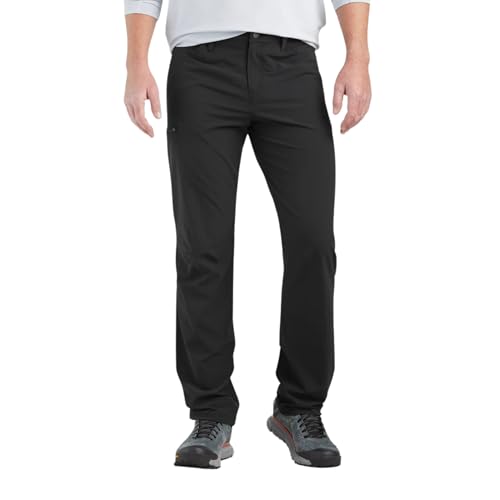
Lower cost within this comparison when a stretch-oriented main pant is enough.
Consider: No measured airflow comparison and no built-in warmth rating.
Check on Amazon
Vent and mixed-panel approach for routes that require repeated adjustment.
Consider: Exact generation matters; more complexity than a simple woven pant.
Check on AmazonEditorial selections from the products considered for this guide; not hands-on test awards. Budget and premium describe positioning, not a guaranteed current price.
Think about the route as a sequence. You might climb through sheltered woodland, cross a ridge, descend into a valley and then wait for transport. The ridge may drive your need for wind coverage, while the climb determines how much ventilation you want. Buying entirely for either segment can leave the rest of the day awkward.
Estimate whether exposure is brief and predictable or a feature of most of the route. A removable layer is easier to justify when its job is concentrated in one part of the walk. If wind is persistent and temperatures are cool throughout, a main pant with more resistant construction may be simpler than repeatedly adding and removing another garment.
Also consider whether you will be moving steadily. A layer that feels comfortable during a climb can feel very different while you stop to eat or wait for another person. This does not mean you need a product with an invented temperature or wind-speed rating. It means the clothing plan must include the quieter portions of the day.
The forecast and route decision remain broader than trousers. No normal hiking pant makes an exposed route appropriate in conditions beyond your preparation. Keep the purchase focused on clothing performance rather than treating a windproof label as permission to ignore the setting.
Wind resistance concerns air movement through the garment. Insulation concerns how the clothing arrangement retains warmth. Water resistance concerns its response to moisture. These can occur together, but evidence for one does not establish the other two. An unlined wind-resistant pant may offer little extra insulation when you are standing still. A fleece-lined pair can feel warm indoors without functioning as a waterproof layer.
The construction of a woven fabric matters. Fiber names such as nylon and polyester do not tell you how tightly the yarns are arranged or whether another layer is bonded to them. Nor does stretch percentage provide a reliable wind-resistance ranking. A highly elastic fabric can be designed in different weights and constructions.
Manufacturers may describe pants as wind resistant without publishing a comparable airflow test. That wording is still useful as a statement of intended function, but it does not allow an honest claim that one model blocks twice as much wind as another. Where comparable measurements are absent, assess the documented construction and acknowledge the limit.
Waterproof shells can also reduce exposure to wind, yet using one for that purpose introduces its own ventilation and fit tradeoffs. The rain guide covers waterproof construction. Here, the question is whether carrying that shell already solves your brief exposed section or whether a different main pant better suits the whole route.
A main pant with a more substantial woven or softshell construction avoids a clothing change when you leave the trees. It can be a good arrangement for a route that stays cool and exposed. Its limitation is that the fabric cannot become lighter once you move into shelter. Vents may help, but they do not remove the rest of the material.
A lighter main pair plus a separate wind layer divides the job. You retain the walking feel you prefer for most of the outing and add coverage for a specific segment. The cost is another item to carry, another fit to check and another change to manage. A very light overlayer may also offer fewer pockets and less tolerance for rubbing against rough surfaces.
If you already carry a suitable rain shell, assess its use before purchasing another layer that largely duplicates that role. It may be practical for a short windy section. For frequent or prolonged use, however, its ventilation and bulk may lead you toward a more specialized arrangement. The answer should come from the route and your existing equipment rather than an assumption that every clothing category deserves a place in the pack.
Work through the change while dressed at home. Can the extra layer go over your footwear? Can you reach its waistband beneath the pack belt? If the transition is inconvenient in a room, it will not become simpler in a breezy stopping place.
A vent is useful only if you can operate it and if its location addresses the way the pants feel during activity. A short pocket opening is not necessarily a purpose-designed ventilation system. Check whether the manufacturer actually identifies a vent, whether there is a mesh backing and whether opening it affects the security of anything you are carrying.
Fjallraven's current Keb Trousers M provide a specific construction example: the manufacturer describes ventilation zips along the thigh and lower leg, alongside G-1000 and stretch panels. This is a different adjustment method from rolling the cuff or detaching the lower leg. Confirm that the exact Keb version you are considering has the stated features; older listings should not inherit a current specification automatically.
Vent access matters under a pack. A zip partly covered by the hipbelt can be difficult to use, and a long opening may interact with a base layer underneath. Try it in the outfit rather than judging it by a photograph. Check the closure again after moving so that fabric is not trapped in the zipper path.
More vents are not automatically worth their price. If your walking is gentle and consistently cool, you may seldom use them. If your route alternates sheltered climbs and open traverses, accessible ventilation can be more relevant than another pocket or a decorative reinforcement panel.
Outdoor Research's Men's Ferrosi Pants are a useful reference for a stretch-oriented main pair. The manufacturer describes wind and water resistance and lists a nylon/spandex blend. They illustrate why a pant need not be heavily insulated to offer some resistance to a breeze. We have not performed an airflow comparison against the other options, so the description should not become an unsupported ranking.
Outdoor Research's Cirque III Pants move toward a more technical softshell arrangement. Manufacturer features include double-weave fabric, an adjustable belt, articulated knees and adjustable ankle details. Those are relevant when you want controlled cuffs and more substantial construction around winter footwear. They also represent additional material and hardware to consider on sheltered, warmer sections.
Fjallraven Keb adds another approach through mixed panels and dedicated vents. Its current manufacturer information identifies different fabrics in the reinforced and stretch areas. That matters when evaluating adjustment and care, not merely when counting fabric percentages. Wax-compatible sections remain distinct from stretch sections.
For the shopping tiers, compare the current selected options rather than assuming a brand always occupies one price level. A discounted technical pair may sit below another model in one size but not another. Budget here means the lower-cost option within this particular comparison, not a claim that Ferrosi is the least expensive hiking pant available.
Wind can enter through garment openings even when the main fabric has useful resistance. Inspect the ankle opening, waistband fit and overlap with the rest of your clothing. A very wide cuff may behave differently from a controlled opening over the same footwear. At the same time, overtightening every opening can create unnecessary pressure and reduce the adjustment you wanted for walking.
An adjustable cuff should remain clear of the sole and moving parts of your footwear. Place any elastic cord as the manufacturer intends rather than leaving it dangling. If you use gaiters, check how all the closures stack together. Extra layers of straps and hems can be awkward even when each individual garment fits well.
During a short outing, note whether the discomfort was constant through the fabric or concentrated around an opening. This helps you distinguish a useful cuff adjustment from a need for different construction. Avoid concluding that the entire fiber category is unsuitable from a single ill-fitting pair.
Your final check is the sheltered return segment. If the pants become uncomfortably warm there and their vents do little to help, a removable layer may serve the route better. If you keep reaching for extra coverage through most of the day, a more resistant main pant may simplify the arrangement. The changeable-weather guide extends this route-sequence approach beyond wind alone.
No. A wind layer can be designed primarily to reduce airflow and may have only limited water resistance. Rain pants require their own waterproof construction assessment. Check the exact garment description rather than treating the two names as interchangeable.
Thickness alone does not establish a comparable result. Weave, coatings, membranes and openings also matter. A published wind-resistance claim is useful context, but without comparable testing it does not support a precise ranking between models.
They add adjustment but do not remove the garment’s weight, lining or reinforced material. Assess how the pair feels during the warmest sustained activity you expect. Vents may broaden its usefulness without turning it into a genuinely lightweight summer pant.
Choose wind coverage for the route segment where you need it, then account for the rest of the walk. Ferrosi offers a lighter main-pant starting point; Cirque III emphasizes technical softshell construction; Keb adds a panel-and-vent approach. None receives a wind-speed rating here because comparable evidence is unavailable. If exposure is brief, test whether a carried layer solves the problem more neatly than heavier trousers. If exposure dominates the day, prioritize a main pair whose cuffs, waist and ventilation remain comfortable throughout the outing.