
Columbia Men's Silver Ridge Utility Pants
A documented partial-elastic waist and gusset provide a practical outer-pant fitting example.
Consider: Actual room over your underlayer must be checked.
Check on Amazonuses
An underlayer changes the inside of a hiking pant before it changes the weather outside. Seams meet new seams, an extra waistband occupies space, and the outer fabric has another surface to slide over. If a pair fits well by itself but feels restrictive over underwear or a base layer, inspect that interaction first. You may need a different layer combination rather than a different trouser size.
Three places to start
As an Amazon Associate I earn from qualifying purchases. Purchases take place on Amazon.
A documented partial-elastic waist and gusset provide a practical outer-pant fitting example.
Consider: Actual room over your underlayer must be checked.
Check on Amazon
Lower-priced outer-pant option if the current pair cannot accommodate the intended layer.
Consider: Buying new pants may be unnecessary; first check the existing combination.
Check on Amazon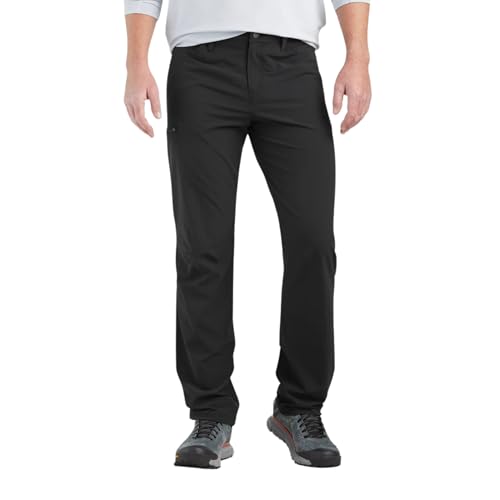
Stretch-oriented fabric offers another outer-layer approach to compare.
Consider: Elastic content does not prove spare room or prevent layer bunching.
Check on AmazonEditorial selections from the products considered for this guide; not hands-on test awards. Budget and premium describe positioning, not a guaranteed current price.
Separate everyday underwear from a longer base layer. Underwear supplies the coverage and fit you normally prefer next to the body. A base layer may add leg coverage or warmth as part of a planned clothing system. The two can overlap in function, but do not assume every long tight is intended to be worn in exactly the same way.
Read the garment instructions and consider your own comfort preferences. This guide does not prescribe a medically ideal fiber, compression level or underwear style. If you have persistent skin discomfort or a health-related reason for a particular garment, seek appropriate personal advice rather than using a shopping article as treatment guidance.
For an ordinary mild-weather walk, adding another full-length layer may be unnecessary. For colder conditions, it may have a clear role, but the outer pants must have enough usable room. Begin with the minimum combination that meets your planned needs, then assess whether it remains comfortable during both movement and stops. The winter layering guide covers the broader cold-weather system.
Put the complete combination on and let each garment settle naturally. Look at whether the underwear waistband sits beneath the trouser button, a drawcord knot or a belt. Add the pack hipbelt if you use one. Several individually comfortable components can create a bulky line when they occupy the same height.
Move the layers only within their intended fit and check whether a small change in rise or style produces a cleaner overlap. Do not fold or roll a waistband tightly merely to hide it from another component. If the arrangement consistently bunches, a differently shaped underlayer may be more effective than tightening the outer waist.
Feel the inner-leg and crotch seam positions while seated and during a comfortable step. Seams need not be absent to be comfortable, and a flat-seam claim does not guarantee a good interaction. The relevant question is where the particular garment places its construction relative to your body and the outer trousers. Check the combination after a few minutes, when layers have had a chance to move.
An added layer occupies some of the space that was available for movement. If the outer pant was already close through the thigh or seat, that change may be noticeable even when the underlayer is thin. Fabric stretch can accommodate some extension, but it can also leave the outer garment under constant tension if there is insufficient room.
Try the same simple sequence with and without the base layer: sit, stand, raise a knee and take a side step. Notice whether the waistband starts dropping, the crotch pulls or the knee becomes restrictive only with the added garment. This comparison helps identify the layer interaction rather than treating the outer pant as the sole cause.
Sizing up is one possible response, but it is not automatically the best one. The larger size may fit the layered thigh while leaving the waist loose or moving the knee shaping out of place. A roomier cut in the appropriate waist size, a different underlayer thickness or a different rise can be a more targeted solution. Choose the combination as a system.
Two similarly thin underlayers can slide differently beneath the same woven pant. Surface texture, knit, seam construction and fit all influence how the layers interact. A smooth feel in the hand is useful information, but it does not fully predict whether the garment will bunch behind a bent knee or twist during walking.
Avoid simple rules such as one fiber always prevents odor, another always causes irritation, or an elastic-rich layer always moves best. Those are broader claims than a fabric label can support. The exact garment, use and care matter. A layer advertised for moisture management also does not guarantee that the whole clothing combination stays dry in every condition.
Inspect whether the underlayer remains in place when the outer pant moves. If it rides upward, the hem or fit may be involved. If the outer fabric grips it, try a different surface or cut before assuming more stretching will solve the issue. The practical result you want is a combination that moves without frequent rearrangement, not a winning fiber in an abstract comparison.
Columbia's current Women's Leslie Falls Pants II pairs stretch fabric with a structured waistband. That combination suggests two separate checks: leg room over an underlayer and waist comfort with another band beneath it. The Pull-On version changes the waist arrangement and published inseams, so it should receive its own fitting rather than inherit the Pants II result.
The referenced men's Ferrosi Pant uses a nylon-spandex blend and has an internal drawcord according to Outdoor Research. Those details may interest a shopper comparing adaptable movement, but they do not establish how a specific long underwear layer will fit beneath it. A highly elastic outer fabric can still be cut closer than you want for layering.
The current prAna Stretch Zion Relaxed offers a relaxed straight pattern, while the Standard is a separately specified model. Their names suggest different cuts, yet the exact measurements and garment on your body decide usable room. Do not apply the current Relaxed fabric and features to an older slim Zion II listing. Model accuracy matters most when a small fit difference changes the layer combination.
Full-length underlayers can create extra material where a trouser hem, sock and boot collar already meet. Let the underlayer finish as designed and assess whether it forms a concentrated band when the footwear is fastened. A thick fold tucked into a boot may feel different from a smooth single layer above it.
Behind the knee, two close garments can gather when seated or deeply bent. Stand up and see whether the layers return comfortably to position. If you repeatedly pull the outer leg down or smooth the inner layer, compare length and cut rather than accepting constant adjustment as inevitable. A longer underlayer is not necessarily better if it creates excess material at the joints.
Add gaiters only if they belong in your intended setup, and evaluate the resulting overlap. Their closure can add another band around the lower leg. The gaiter interface guide addresses that outer connection. Here, the objective is to keep the inner layers from making a previously comfortable cuff-and-footwear arrangement bulky or restrictive.
Check that the inner garment is the intended length before blaming the outer hem. Extra base-layer fabric can collect at the ankle even when the hiking pants have the correct inseam. A different inner length may remove that bunching while preserving the outer garment you already like. This is another reason to evaluate each layer's role before replacing the most visible item in the combination.
A layer that is comfortable while walking can still be awkward to change in the settings available on your trip. Consider whether removing it requires taking off footwear and outer pants, and where you could reasonably do that. This does not mean every layer must be removable instantly, but the adjustment plan should be realistic.
Follow each garment's own care instructions. Two pieces worn together may need different washing or drying methods. Do not assume a base layer can share a high-heat cycle simply because the outer pants permit it, or that a treatment suitable for one material belongs on the other. Keep care labels available until you know the routine.
Finally, distinguish a need for new trousers from a need to reassess the underlayer. The shopping examples on this page are outer-pant comparisons if your current pair lacks suitable room or waist comfort. They are not a claim that you need to replace usable pants in order to wear underwear or add a base layer. An inexpensive change to the combination, or no purchase at all, may resolve the actual problem.
No. It is an optional layer chosen for a particular purpose and set of conditions. Assess whether it adds useful coverage or warmth and whether the outer pants accommodate it. More layers are not automatically more comfortable.
Appearance is secondary to a comfortable, stable overlap. A small visible edge is not necessarily a fit problem, while hidden bulky bands can be uncomfortable. Check the arrangement seated and under any pack belt you use.
Some may work comfortably, but thickness, seams, waistband and intended use differ. Try the exact combination and follow the garment guidance. A studio legging or reinforced trail tight should not automatically be treated as identical to purpose-designed long underwear.
The extra material may reduce available room at the seat, thigh or knee, or two waistbands may stack under pressure. Compare the combination with and without the layer to locate the cause before changing trouser size.
Choose underlayers by their purpose and their interaction with the outer garment. A comfortable system lets the waistbands coexist, the knees bend and the hems settle without repeated rearrangement. Compare the complete combination in motion and while seated, using the pack and footwear you actually expect to wear. If it fails, change the specific mismatch rather than automatically adding stretch or sizing up. The right answer may be a different underlayer, a roomier cut or simply leaving an unnecessary layer out.