
Columbia Men's Silver Ridge Utility Pants
Documented waistband and pocket features create a balanced pack-fitting candidate.
Consider: No pants-only choice settles route weather or spare-clothing needs.
Check on Amazonuses
A day-hike fitting session rarely includes tomorrow morning, when the same trousers may be creased, partly damp and going back under the same loaded hipbelt. Backpacking asks more of the daily routine than of any single impressive feature. Select pants around repeated wear, limited washing opportunities and the pack that stays with you, then decide which compromises you can live with for several days in succession.
Three places to start
As an Amazon Associate I earn from qualifying purchases. Purchases take place on Amazon.
Documented waistband and pocket features create a balanced pack-fitting candidate.
Consider: No pants-only choice settles route weather or spare-clothing needs.
Check on Amazon
A lower-priced option to evaluate on shorter outings before multi-day use.
Consider: Utility branding does not establish long-distance durability or drying time.
Check on Amazon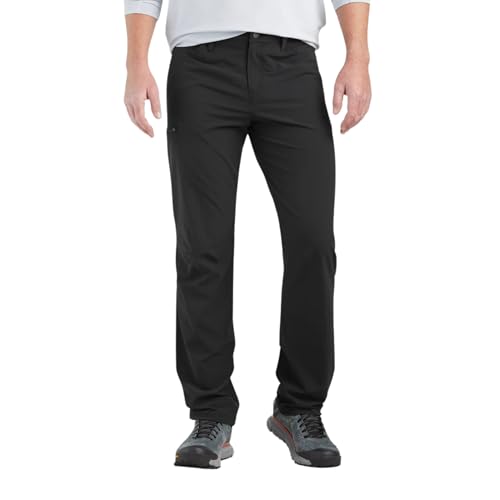
Primary drawcord and waistband detail offer a different interface to assess under a pack.
Consider: Harness-related marketing is not proof of compatibility with every hipbelt.
Check on AmazonEditorial selections from the products considered for this guide; not hands-on test awards. Budget and premium describe positioning, not a guaranteed current price.
Sketch a typical day and the following morning. You may walk, sit for breaks, set up camp, change layers and put the trousers on again before there is a convenient laundry opportunity. Think about where the garment can air, whether spare clothing is available and what you expect it to do while the rest of your kit is packed.
This exercise changes the shopping priorities. A convenient pocket opening may matter every hour, whereas a rarely used accessory loop may not. A waistband that feels slightly intrusive for ten minutes can become a persistent annoyance under a loaded pack. A complex hem adjustment may be worthwhile if it handles your footwear well, or unnecessary if you never change its setting.
Do not interpret multi-day use as a reason to tolerate a poor fit. Repeated wear magnifies small discomforts rather than proving the trousers will eventually adapt. Start with a design that sits comfortably, moves without concentrated pulling and does not depend on carrying the belt excessively tight. Those qualities are more useful than a promise of expedition readiness.
Include the first minutes after a stop in that daily sketch. A waistband adjusted while seated may need a small correction once the pack is back on, and a pocket item moved during lunch may end up under the hipbelt. A brief consistent check before resuming can reveal these changes. Choose clothing whose controls remain easy to understand when your attention is on organizing the rest of your kit.
Load your pack as you reasonably expect to carry it, using an appropriate and comfortable weight for your fitting exercise. Settle the hipbelt in its ordinary position. Then look at the overlap with trouser buttons, drawcord knots, webbing adjusters and belt loops. A low-profile component can still sit in precisely the wrong place for your body and pack.
Walk and sit with that combination. Notice whether the trousers creep downward or whether the waistband folds beneath the belt. If you need to reach a drawcord to make adjustments, check that it remains accessible. A waistband described as harness compatible is useful manufacturer context, but a climbing harness and your backpack hipbelt are not the same object.
The referenced men's Ferrosi Pant includes an internal drawcord and a lined waistband in Outdoor Research's description. Columbia's current Silver Ridge Utility Pant has a removable belt and partial elastic waist. These are different approaches worth trying under a pack. Neither establishes universal pressure-free performance, and a removable supplied belt may give you options only if the trousers still fit properly without it.
Backpacking can tempt you to fill every pocket because many small objects need a home. Begin instead with what must be reachable while the pack stays on. A phone, a small snack or another frequently used item may earn trouser space. Items used only at camp can usually remain in an appropriate part of the pack.
A hard object under the hipbelt can produce an avoidable pressure point, and a loaded thigh pocket can swing during a long descent. Test the arrangement with the actual objects. If a zipper is covered by the belt, decide whether occasional access is acceptable or whether that compartment is effectively unavailable during walking.
Repeat the pocket check after the pack has settled. Belt position can change slightly as you move, making an initially accessible opening awkward. Use a consistent small-item routine so you know what belongs where. Our pocket planning guide explains device fit and closure choices; the backpacking priority is to preserve access without turning the trousers into an overloaded second pack.
A quick-dry claim is not a promise that pants washed at dusk will be ready at dawn. Air movement, humidity, water retained in seams and the available hanging space all influence the outcome. A thick waistband or multilayer pocket may remain damp after broad fabric panels feel dry. Plan around the actual opportunities on your route.
For a trip with regular lodging and laundry access, following the garment's care label may be straightforward. For several nights outside, you may have fewer options. If washing clothing is appropriate and permitted, keep the process away from natural water sources and follow local land guidance. Appalachian Trail Conservancy and National Park Service Leave No Trace guidance are relevant starting points; biodegradable soap is not permission to wash directly in a stream.
Separate airing from cleaning. Hanging a garment in a suitable place may help it dry, but it does not replace a proper wash when needed. Avoid promising odor-free performance from a fiber choice or treatment. Choose a routine that respects the garment, the land and the reality of your trip rather than assuming a marketing term solves all three.
The waist, seat, knee and cuff meet different surfaces over a backpacking day. Identify which contacts dominate your route and habits. A long hem brushing a shoe at every step can accumulate more wear than an occasional rough seat. Fixing the length may be more valuable than adding material elsewhere.
Fjallraven's current Vidda Pro lists reinforced rear and knees, while the current prAna Stretch Zion Relaxed lists a rear cuff scuff guard. Those model-specific details address different locations. A heavier reinforced design may suit some repeated contact, but the added mass and fabric feel still need to work for the conditions. Reinforcement is not protection against every hazard.
Before departure, inspect closures, pocket bags and obvious seam problems. If a critical fastening already slips or catches, address that issue through an appropriate repair or seller route. Do not rely on a long trip to reveal whether a questionable component will survive. This is ordinary preparation, not a laboratory durability test or a prediction of service life.
A pair of convertible trousers offers two coverage configurations but remains one main garment. If the seat or waist becomes unusable, detached legs do not provide an independent backup. Likewise, a base layer may serve a separate warmth role without being the walking trouser you want for every part of the route.
Decide what each piece contributes: walking coverage, a dry change, sleep clothing, rain protection or another specific task. Avoid counting one feature twice just because a product page calls the design versatile. A fixed-leg pant plus separate shorts may be appropriate for one itinerary; a convertible alone may be enough for another. The role of a spare is the key distinction.
Whole-garment weights are useful only when compared sensibly. Reference sizes vary, and fabric mass is not garment mass. If minimizing carried weight is important, weigh the actual pieces you plan to pack rather than adding incompatible manufacturer figures. Keep that decision proportionate to comfort and function; the lightest single item may not produce the most workable clothing system.
For a familiar route with predictable weather and frequent washing access, a relatively simple woven pant may be sufficient. For varied temperatures, an adjustable hem or convertible leg can provide a useful coverage change. For repeated rough contact, targeted reinforcement may matter more. Start with the route requirements instead of purchasing every feature simultaneously.
The current Silver Ridge Utility provides an example of a moderate-price design with partial elastic, a gusset and mixed pocket closures. Ferrosi listings offer a higher-priced alternative whose exact version should be checked against the manufacturer's movement and waistband details. A lower-priced ATG Synthetic Utility listing can also enter the fitting comparison, without assuming its title proves any particular long-trail capability.
Use shorter outings to evaluate the chosen arrangement before relying on it for repeated days. Note a specific problem if one appears: belt pressure, inaccessible phone, trailing cuff or an inconvenient wash routine. Adjust the cause rather than replacing the entire system immediately. A successful backpacking pant is part of a repeatable daily routine that continues to work when the novelty of the purchase has worn off.
Not automatically. Longer use increases the importance of fit, repeatable care, repair options and route-specific conditions. Those needs may lead to a different model, but a thru-hiking label does not establish special performance or eliminate ordinary fitting checks.
That depends on the itinerary and the other clothing already in your pack. Identify what you can appropriately wear while the walking pair is cleaned and dried. A spare can be useful, but it should have a clear function rather than being added by habit.
Check local storage guidance and the nature of the contents, especially anything scented or food-related. Emptying and inspecting pockets also helps keep the morning routine clear. Do not assume trouser storage is appropriate simply because an item is small.
Choose backpacking trousers for the second, third and fourth wear, not only for a convincing first fitting. The waistband must coexist with your pack, storage must remain usable, and the care plan must fit the itinerary. Keep clothing roles clear and select reinforcement or conversion features only when they address a real need. A shorter trial outing can expose avoidable friction before a longer commitment. The strongest multi-day choice is the pair that supports a calm, repeatable routine across walking, stopping, airing and starting again.