
Columbia Men's Silver Ridge Utility Pants
A clearly documented starting point for comparing movement, waistband and storage features.
Consider: Utility specifications should not be assumed for older Silver Ridge models.
Check on Amazonfoundations
A pair of trousers does not become necessary equipment just because its label says hiking. The useful question is what happens when you climb a high step, sit on rough ground, get caught in drizzle or wear a loaded backpack. Hiking pants are designed around some combination of those situations. Understanding that combination makes it easier to recognize a useful upgrade—and to keep wearing a pair that already works.
Three places to start
As an Amazon Associate I earn from qualifying purchases. Purchases take place on Amazon.
A clearly documented starting point for comparing movement, waistband and storage features.
Consider: Utility specifications should not be assumed for older Silver Ridge models.
Check on Amazon
A less expensive way to consider a dedicated utility trouser for ordinary walks.
Consider: Evaluate actual fit and listing details; price does not establish drying or durability.
Check on Amazon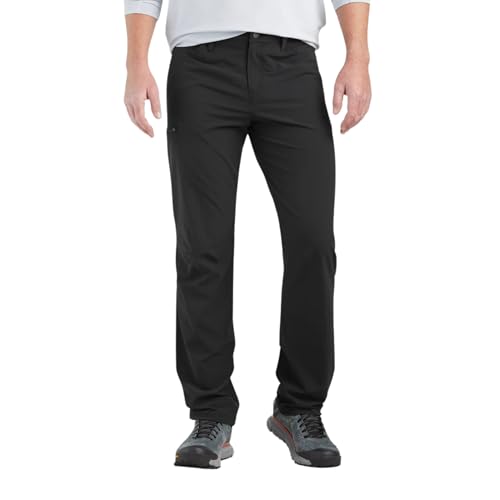
Worth comparing when movement and a technical waistband matter to your setup.
Consider: Water resistance is not waterproofness; exact inseam must match your needs.
Check on AmazonEditorial selections from the products considered for this guide; not hands-on test awards. Budget and premium describe positioning, not a guaranteed current price.
There is no single hiking-pants formula. Some models use a light woven fabric and restrained pockets. Others add heavier panels, large thigh storage or detachable lower legs. A softshell trouser intended for cooler conditions can feel very different from an unlined summer pair even when both appear under the same shopping heading.
The shared idea is to accommodate outdoor walking rather than prioritize only office appearance, gym movement or uniform storage. That intent does not establish a universal performance standard. A listing that says “outdoor” may describe the intended market without telling you anything precise about seam construction, drying time or the amount of stretch.
Separate three questions when reading a description: what the garment is made from, how it is shaped, and which conditions its manufacturer actually addresses. Those questions reveal more than the number of activities printed in a product title. They also keep useful everyday trousers in consideration when your planned walk is straightforward.
An uphill step asks for room across the knee and seat. A high curb can reveal whether the fabric stretches comfortably or whether the whole waistband pulls downward. A crotch gusset or shaped knee may provide movement even when the fabric contains little elastic fiber. Conversely, stretchy fabric cannot always rescue a cut that is too small.
Outdoor pockets face a different test from pockets used while standing. A phone can strike the thigh with each stride; a deep pocket may become awkward to reach beneath a pack hipbelt. Secure closures can help retain small items, but a zipper placed exactly where a belt presses can create an avoidable lump.
Cuffs interact with shoes, boots and the ground. An overlong hem that looks acceptable indoors may drag through mud. A very narrow opening may catch on a boot when sitting or stepping. These are fit problems rather than proof that one overall style is superior. Check the combination you intend to wear.
Weather introduces another set of compromises. A light fabric may be pleasant while moving but provide little warmth during a long stop. A water-repellent surface may shed brief droplets without being waterproof. The practical benefit comes from knowing those limits before choosing a pair, not from assuming a technical-looking garment covers every possibility.
Columbia's Men's Silver Ridge Utility Pant illustrates a feature-led lightweight design. The manufacturer describes the current 2012951 style as recycled polyester with a gusset, partial elastic waist and security storage. Those details give a buyer specific things to evaluate. They should not be transferred to an older Silver Ridge Cargo or another similarly named model.
Outdoor Research's Men's Ferrosi Pant provides another interpretation. Its manufacturer describes a nylon-and-spandex construction, waist adjustment and zippered storage. A buyer interested in movement and a relatively uncluttered setup might compare it with the Columbia. That is a construction comparison, not a claim that we have tested one as more breathable or longer lasting.
ATG by Wrangler's Men's Synthetic Utility Pant appears as a lower-priced alternative in the reviewed listings. Its practical role here is to show that trying an outdoor-oriented trouser does not require selecting the most expensive option. Read the actual product details and check fit; a favorable price cannot establish fabric performance that the listing does not document.
These examples are starting points, not a required three-pair wardrobe. Choose one suitable configuration if you need it. If your current trousers already give you the movement, coverage and storage required for your walks, learning the category may confirm that no purchase is necessary yet.
Start with clean, dry trousers and the shoes you plan to use. Walk around, climb a comfortable step, sit down and bend each knee. Notice where the waistband moves and whether the fabric pulls across the seat. A pair that requires repeated hitching or a belt tightened to compensate for an oversized waist deserves closer attention.
Next, carry the things you normally keep on your body. Sit with a phone in its usual pocket. Try reaching the pocket while wearing your backpack. Remove unnecessary objects before deciding that you need more storage: adding pockets is not the only way to improve the arrangement.
Look at the hem from the side and behind. It should not rely on a large pile of fabric above the shoe to stay off the ground. Check the length again with one knee raised. If you alternate trail shoes and bulky boots, the same cuff may behave differently with each.
Finally, consider a realistic interruption. Could you comfortably wear the pair on the ride home after it gets dirty? Would it dry between outings using the facilities you have? Do you need room for another layer on the route you are planning? These everyday questions often identify a more useful upgrade than chasing a headline fabric claim.
A short walk on maintained paths in settled conditions may place modest demands on clothing. Comfortable trousers that allow movement can be sufficient. You can learn what bothers you through ordinary local walks before spending money on features you may never use.
Keeping an existing pair also makes sense when the problem is small and fixable. Emptying an overloaded pocket, choosing a different belt or shortening a conventional hem may solve more than buying a different brand. Check alteration feasibility before modifying trousers with ankle zips, drawcords or other integrated parts.
There are limits to repurposing. Heavy fabric that stays uncomfortable after getting wet, a restrictive seat or a waistband that conflicts with your pack can become persistent annoyances. Longer trips give those annoyances more time to matter. Use the expected outing, rather than the popularity of the activity, to decide whether an upgrade has a purpose.
For a direct comparison with everyday denim, see hiking pants versus jeans. That discussion is more useful than treating every ordinary trouser as the same category. Fiber, weight and fit vary too much for a simple hiking-label-versus-no-label verdict.
Convertible legs are optional. They can be useful when you regularly change coverage, but they add zippers and a second set of pieces to manage. If you never want shorts during an outing, full-length pants can be the simpler choice. Roll tabs offer a different compromise rather than an automatic substitute.
Large cargo pockets are optional as well. They suit particular items, but carrying the same objects in a pack may produce less movement at the leg. Do not choose pocket count without testing the size, position and closure you would actually use.
A heavier or more reinforced model is not automatically the sensible first purchase. Added material may serve frequent contact with rough surfaces, while a less substantial design can suit groomed paths. Similarly, a lining changes flexibility across temperatures. It is worth paying for a solution to a repeated need, not a feature that only sounds reassuring.
Before browsing, finish this sentence: “My current trousers make this part of walking inconvenient.” The answer might be restricted knees, an unsuitable hem, slow overnight drying or inaccessible pockets. That becomes your first filter. Color and styling can still matter, but they should not conceal whether the new pair fixes the original problem.
Use the route-based selection guide when you are ready to compare options. The men's collection and women's collection then provide shopping routes. Department labels are starting points; exact body measurements and the model's chart remain more useful than assuming a familiar size will transfer unchanged.
After a suitable local walk, review the specific issue that prompted your interest. Did you adjust the waist less often? Could you reach your phone without stopping? Did the cuff stay where you expected? These observations belong to your own fitting and use experience, not a universal ranking. A trouser that quietly solves those small problems may be a successful choice even if it lacks some features shown on more elaborate models. Keep that result as the benchmark for future purchases instead of starting the search from scratch.
Ordinary hiking pants should not be treated as protective equipment. They provide clothing coverage, but a hiking label does not establish protection against bites, impacts, dangerous weather or other hazards.
No. Pocket requirements depend on what you carry and where you carry it. A well-positioned secure pocket can be useful, while a zipper that sits under your hipbelt may be inconvenient.
Yes. For appropriate local outings, assess comfortable clothing you already own against expected conditions and movement. Replace it when you can identify a limitation that a suitable new pair would address.
Treat hiking pants as a set of practical design choices rather than an entry ticket to walking outdoors. The strongest first purchase solves a problem you can name and fits the equipment you already use. Silver Ridge Utility, Ferrosi and an ATG utility option illustrate different places to begin comparing, but none removes the need for a movement check. Keep a satisfactory existing pair; buy deliberately when fit, drying, coverage or storage has become a repeated obstacle.