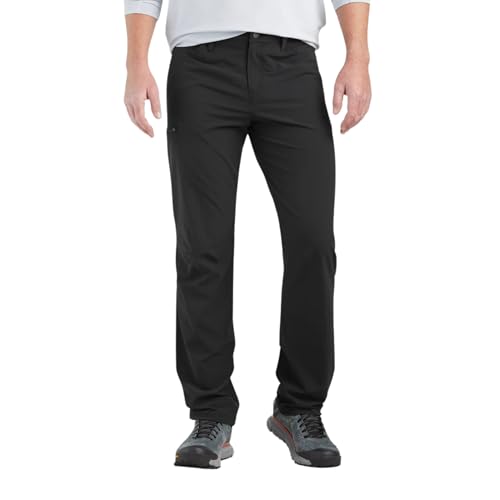
Outdoor Research Men's Ferrosi Pants
A stretch-oriented alternative when movement is the reason to replace everyday denim.
Consider: Check the waistband and loaded fit rather than assuming stretch solves sizing.
Check on Amazoncomparisons
A short walk does not become inaccessible because the trousers in your wardrobe are denim. The more useful question is when those jeans stop being a comfortable match for the outing. A stiff knee, an awkward loaded pocket or a wet garment you cannot readily dry is a specific problem. A hiking label is only useful if the replacement addresses it without creating a different fit or spending problem.
Three places to start
As an Amazon Associate I earn from qualifying purchases. Purchases take place on Amazon.
A stretch-oriented alternative when movement is the reason to replace everyday denim.
Consider: Check the waistband and loaded fit rather than assuming stretch solves sizing.
Check on Amazon
A lower-cost listed option to compare when you want a different trail-oriented cut and pocket arrangement.
Consider: Match the exact listing and variant; current manufacturer naming differs.
Check on Amazon
Compare when vents and reinforced panels address needs that casual jeans do not.
Consider: The additional construction is unnecessary for many easy everyday walks.
Check on AmazonEditorial selections from the products considered for this guide; not hands-on test awards. Budget and premium describe positioning, not a guaranteed current price.
Denim is not one universal fabric recipe. Read your pair's label and inspect its cut before comparing it with an imagined ideal hiking pant. Stretch jeans, rigid jeans, lined jeans and different fabric weights are not interchangeable. A roomy familiar pair may move more comfortably than a badly sized technical pant, even if the latter has an impressive list of features.
Notice which parts feel restrictive during ordinary wear. A tight waist when seated, a knee that resists bending or a crotch seam that pulls during a high step gives you a precise target. If none of those issues appears on a short local walk, there may be no immediate replacement problem. Starting from a garment that already works is often more useful than shopping from a categorical rule.
Also check condition. A frayed seam or failing closure can make any pair a poor candidate for an outing, regardless of whether it is denim or synthetic. This is an inspection of the individual garment, not a claim that one category is universally durable. Repairable wear may call for a repair, while an unsuitable cut may call for a different garment altogether.
Consider how easy it would be to change plans if you became uncomfortable. A familiar park loop close to home and a remote trip with an overnight pack place different demands on the same pair of jeans. There is no precise distance at which denim suddenly stops working. Terrain, forecast, effort, stops and the ability to change clothes are more informative than a single mileage number.
For a casual walk in appropriate settled conditions, clothing you already know may be a sensible starting point. If the route includes frequent high steps, long periods away from shelter or a need to keep wearing the same garment the next morning, the comparison deserves more attention. Those details create concrete reasons to investigate mobility, weather layers and drying arrangements.
Avoid interpreting this as a claim that hiking pants eliminate the consequences of poor planning. An ordinary woven trail pant is not automatically waterproof or insulated. Replacing jeans with a different label cannot substitute for checking conditions and carrying the clothing the outing actually requires. The route-based selection guide connects those separate decisions.
A pair can look comfortable in a shop and resist the first substantial step uphill. Bend and raise each knee, sit on a low seat, and take a long controlled step. Pay attention to whether the waistband is dragged downward or the crotch seam is pulled tight. Those observations distinguish a useful movement problem from a preference about the appearance of denim.
Hiking pants may create room through a gusset, shaped knees, stretch fabric or a more generous pattern. The current prAna Stretch Zion Relaxed Pant combines a nylon-elastane fabric with a vented gusset and an adjustable waist. That construction is worth comparing with restrictive jeans, but it does not mean every Zion version shares the same fit or that the correct size can be skipped because the fabric stretches.
Try both garments with the footwear and underlayers you would normally use. A longer jeans hem can gather differently around a boot than a trail pant with a narrower opening. You are checking the complete fit, not proving that cuffs need a particular technical feature. If your only problem is excess length, a suitable alteration may be more direct than buying a whole new category of trousers.
If a garment becomes wet, ask what happens next. Can you change at home shortly afterward, or will you keep wearing it through a stop and into the following day? A substantial wet garment can be inconvenient to carry and dry. The exact result depends on fabric, thickness, construction and conditions; there is no honest fixed drying time for all jeans or all hiking pants.
Check the care label before assuming that aggressive heat will solve a drying problem. Stretch fibers, finishes, closures and trims may have their own care requirements. For travel or overnight use, the available drying space matters as much as the promise of a quick-drying fabric. A garment packed damp inside a bag is not in the same situation as one hung with airflow.
Many hiking pants use synthetic fabrics and manufacturers may describe them as quick drying or water resistant. Treat those as specific product claims, not proof that the garment will stay dry in sustained rain. Columbia Silver Ridge Utility, for instance, is a recycled polyester pant with Omni-Wick; that does not establish waterproof shell construction. Rain protection remains a separate decision addressed in hiking pants and rain layers.
The narrow practical point is to avoid choosing clothing solely for the first dry hour if the plan depends on wearing it comfortably after it becomes damp. You can sometimes solve that with a change of clothes or a different outing plan. In other circumstances, another fabric and a compatible weather layer are more useful. Neither answer requires declaring every cotton-containing garment identical.
Decide which qualities of your jeans you want to retain. A structured feel and everyday appearance are different preferences from fast trip laundry. Mountain Hardwear's Hardwear AP and AP Active illustrate why that distinction matters: the AP is cotton-rich, while AP Active takes a nylon-rich direction. A different outdoor silhouette could improve movement without making the material change you intended. Confirm the actual replacement goal before choosing between those approaches.
This distinction prevents an expensive but unhelpful purchase. If your concern is the behavior of your current fabric when damp, buying a different-looking garment without reading its composition may not answer that concern. If your concern is knee movement or pocket position, a cotton-containing blend may still address the relevant fit issue. Match the change to the problem rather than insisting that one fiber settles every decision.
The dedicated cotton hiking-pants guide examines the material question more closely. For the jeans comparison, use the label to confirm what is changing. Then ask about the pattern, waist and storage, because those can change even when two garments share a substantial proportion of one fiber.
Traditional jeans pockets can be convenient in everyday use and awkward under a pack belt. A phone in a front pocket may cross the hip crease; a rear-pocket object may become uncomfortable when seated. Hiking pants can relocate those objects, but additional cargo pockets are not automatically better. Their contents may press against the knee or move with every step.
Pack the items you really carry and see whether you can reach them while wearing the backpack. If most essentials already live in the pack, a simple pant may be adequate. If you frequently check a map or phone, a secure accessible pocket could be a meaningful upgrade. Avoid turning a small storage improvement into a requirement to carry everything on your legs.
The Wrangler ATG Synthetic Utility listing is a budget-positioned comparison candidate, while Ferrosi offers a different stretch-oriented approach and Keb adds a more elaborate panel-and-vent arrangement. These are not three reasons to discard perfectly serviceable jeans. They are examples to investigate after deciding whether storage, mobility or more specific trail construction is the thing you are missing.
Write down the one or two limitations that repeatedly bother you. If the answer is simply that your jeans do not look like outdoor clothing, consider whether that matters enough to you to spend on it. Personal style is a valid preference, but it should not be disguised as a performance requirement. Conversely, a recurring movement or drying problem is a clear reason to consider something different.
When you compare candidates, preserve what already works: rise, inseam, waist comfort and a pocket location you like. A replacement that improves one technical attribute while fitting poorly may be less useful overall. Keep your familiar jeans for the situations they handle well and choose another pair for the situations they do not. That is a more practical wardrobe than forcing a single garment to cover every kind of day.
No. Stretch content alone does not describe weight, drying behavior, seam layout or pocket placement. It can help a particular pair move, but you still need to assess the exact garment and outing. Two stretch garments may address very different priorities.
Not necessarily. Inspect and move in the clothes you already own, and choose a route and conditions that suit your experience and clothing. If the jeans remain comfortable and the outing is appropriate for them, a technical purchase does not have to precede every walk.
No. Some include substantial cotton, and ordinary water-resistant hiking pants are not necessarily rain shells. Check the composition and weather construction of the exact model. If the actual need is sustained rain protection, compare a suitable weather layer rather than relying on the hiking label.
Yes. A mixed wardrobe can be more useful than insisting on one garment for every purpose. Keep the pair that suits casual wear and add another only for a defined need, such as a preferred movement pattern, secure trail storage or more manageable trip laundry.
Keep jeans in the comparison as a real garment you know, not a straw-man version of stiff denim. If they suit the route and remain comfortable, there is no need to replace them on principle. When a repeated limitation appears, select a hiking pant that demonstrably changes that particular detail. Read the fiber label, test movement and inspect pocket placement. The worthwhile upgrade is a better fit for your outings, while weather layers and trip planning retain their own separate jobs.