
Columbia Women's Leslie Falls Pull-On Pants
Primary evidence confirms a pull-on waist to compare against a button-and-zip fly.
Consider: Passing the waistband over the hips and any adjustment still require a personal check.
Check on Amazonuses
A fastening can be easy for one person and frustrating for another, especially when it requires a small pinch, a precise alignment or two hands working against fabric tension. Instead of looking for a universal easy-close pant, break the dressing task into the motions you want to simplify. The best choice may involve fewer fastenings, a more reachable pull or a waistband that does not need opening at all.
Three places to start
As an Amazon Associate I earn from qualifying purchases. Purchases take place on Amazon.
Primary evidence confirms a pull-on waist to compare against a button-and-zip fly.
Consider: Passing the waistband over the hips and any adjustment still require a personal check.
Check on Amazon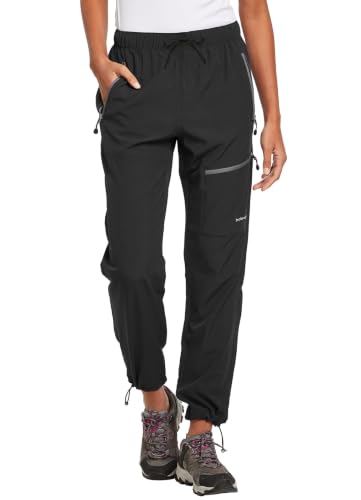
Lower-priced captured elastic-waist listing for evaluating a simpler dressing sequence.
Consider: Exact drawcord, pocket pulls and selected version must be inspected.
Check on Amazon
Higher-priced women’s transit model to investigate if its exact closures meet your preferences.
Consider: No accessible-design certification or universal ease claim; closure details must be confirmed.
Check on AmazonEditorial selections from the products considered for this guide; not hands-on test awards. Budget and premium describe positioning, not a guaranteed current price.
Begin with a pair you already own and identify the exact step you would like to change. Is it pushing a button through a tight hole, locating a small zipper pull, holding two sides together or reaching an adjuster behind the hip? A specific answer lets you compare construction meaningfully. The word accessible on its own cannot tell you whether a garment addresses your preferred way of dressing.
Consider whether the difficulty comes from the fastening itself or from tension in the garment. A button under strain may be harder to operate because the waist is too tight. A zipper may feel awkward because pocket contents pull the fly out of alignment. First assess whether an appropriate fit and a lighter load improve the task; a different closure is most useful when it addresses the remaining problem.
Think about the positions you use comfortably. You may prefer to dress seated, make waist adjustments standing, or use a stable support while managing footwear. This article does not prescribe a technique or assume a particular ability. Build the fitting check around your ordinary routine and any personal guidance you already follow.
If you are choosing clothing for someone else, involve that person in the comparison wherever possible. Their preferred grip, reach and appearance may differ from what a helper assumes is easiest. A fastening that is simple for another person to operate may not be the one the wearer wants for independent use. The decision should serve the actual wearer and task.
It can help to record whether the difficulty occurs every time or only when the garment is under a pack, layered over another waistband or damp from ordinary use. That context may reveal that location and tension matter more than the fastening category. Keep the observations descriptive so you can ask a seller or manufacturer a precise question about the component you need to inspect.
Count the necessary actions from a closed garment to a usable opening. A conventional fly might require a button and zipper; another design may add a second button, hook or webbing adjustment. Each individual component can look simple in a close-up while the full sequence takes more coordination than expected. Try it in the order you would actually use.
Buttons require alignment and movement through a hole, with the details depending on size, stiffness and surrounding fabric. Snaps replace that threading action with pressure to engage and force to separate. Zippers require a graspable pull and a path free of trapped fabric. These are different actions, not a universal ranking from easiest to hardest.
A pull-on waist removes the front opening sequence but introduces another demand: the waistband must pass comfortably over the hips and return to a stable position. A drawcord may then need adjustment. If tying or untying is the part you find difficult, a pull-on garment with a required knot may not simplify the whole routine as much as the name suggests.
Columbia's current Women's Leslie Falls Pull-On has a documented pull-on waistband. The separate Leslie Falls Pants II uses a structured waist and button-and-zip fly. These models provide a clear mechanism comparison, but their different published inseams and fits also need attention. Choose the complete garment, not only the front closure you find appealing.
Look at the zipper pull or adjustment tab in the actual selected garment. Determine whether you can locate it by sight or touch in the way you prefer. A photograph may show the pull enlarged, hiding how small it is relative to a hand. If gloves are part of your ordinary use, repeat the task with those exact gloves rather than assuming a bare-hand result will transfer.
Try the operation with the trousers both lightly tensioned and comfortably worn. A zipper that moves smoothly while the garment lies flat can be harder to use on the body if fabric is pulled across it. Do not force a catching slider. Check for trapped material and fit issues, and follow the manufacturer's guidance for any persistent problem.
Reach matters at pockets as well as the fly. A side or rear security zipper may be easy to operate on a hanger but awkward under a jacket or pack hipbelt. If you need frequent access, choose a position you can reach comfortably. A rarely used compartment can have a different priority, provided you know its limits.
Avoid assuming an added cord loop is automatically an appropriate fix. Some manufacturers offer suitable pull accessories or guidance, while an improvised attachment may catch, damage the component or change how it closes. Ask about the exact product if a modification would be central to usability. A garment that works without an unverified alteration may be the more straightforward purchase.
Repeat a realistic restroom sequence, using the position and support that suit you. Check whether a belt must be loosened separately, whether a drawcord knot is easy to manage and whether the garment can be returned to a comfortable fit without prolonged adjustment. This is a practical clothing assessment, not a test of speed or dexterity.
Then consider a mid-walk change such as loosening the waist, opening a pocket or adjusting a hem. Some trousers put toggles inside the leg or snaps on the side of the calf. Those locations may be convenient for one wearer and hard to reach for another. A simpler straight hem can be a useful choice if lower-leg adjustment adds a task you do not want.
Convertible designs deserve a separate decision because they add two circumferential zippers and detached pieces to handle. If changing coverage is important, rehearse the complete operation with footwear. If it is not important, leaving out that feature reduces the number of closures on the garment. More functions are not automatically more usable.
Finally, imagine preparing the trousers for washing. Hidden pockets, several zipper pulls and multiple detachable parts all require attention. You may be comfortable with that routine, or prefer a design with fewer places to check. The best closure arrangement supports the whole ownership experience, including care, rather than making only the first dressing step easier.
Use a small comparison that deliberately varies the mechanism. One candidate might have a pull-on waist, another a conventional fly and another an internal adjustment with a different grip. Record what works in plain terms: the waistband passes comfortably over the hips, the pull is easy to locate, or the rear pocket is difficult to reach. Those notes are more useful than a generic accessibility score.
The catalog's Columbia Leslie Falls Pull-On provides an identifiable pull-on candidate. A lower-priced BALEAF quick-dry hiking listing that explicitly identifies an elastic waist offers another option to inspect, but do not assume every BALEAF model has the same drawcord or fastening. Outdoor Research's women's Ferrosi Transit listing sits at a higher captured price and needs its own exact closure verification; the Ferrosi family name is not a specification.
Do not equate premium price with easier operation. A more expensive pant may add hardware that is valuable for another purpose but unnecessary for your routine. Equally, a budget garment may have a mechanism you prefer while needing careful evaluation of fit and construction. Choose by successful actions and suitable garment shape, then use price as part of the overall comparison.
If the requirements are specific and ordinary hiking designs do not meet them, consider clothing explicitly designed around those requirements and seek relevant personal or occupational advice where appropriate. We do not claim these ordinary products are medically adaptive garments. The useful outcome is a well-understood option, or a clear reason to keep looking, without pretending that one fastening can solve every dressing need.
No. A snap removes the threading-through-a-hole action but may require pressure to close and force to open. The surrounding fabric and garment tension matter too. Compare the exact mechanisms using the grip and position that work for you.
Only if the waistband fits securely without an adjustment you find inconvenient, or the design offers another suitable mechanism. Pull-on describes how the garment goes on; it does not guarantee that no tying or fine adjustment is required afterward.
Check the manufacturer guidance for that component and any compatible accessory. An improvised loop can catch or alter operation. If an attachment is essential to usability, verify the solution before relying on the garment for an outing.
Yes. Reach, pull size and interference from a pack or jacket can matter as much as the main fly. Test the compartments you will actually use with ordinary contents inside, including opening and closing them in your preferred position.
Choose closures by the motions you want to make easier, then test the entire sequence rather than one isolated component. A pull-on waist may remove a fly operation, a different zipper pull may improve grip, and a simpler hem may eliminate unnecessary reaching. Each benefit still needs a suitable fit and a routine that works for the wearer. Keep the comparison personal and concrete, avoid assuming that price predicts usability, and do not rely on unverified modifications or medical claims to make an ordinary garment sound universally accessible.