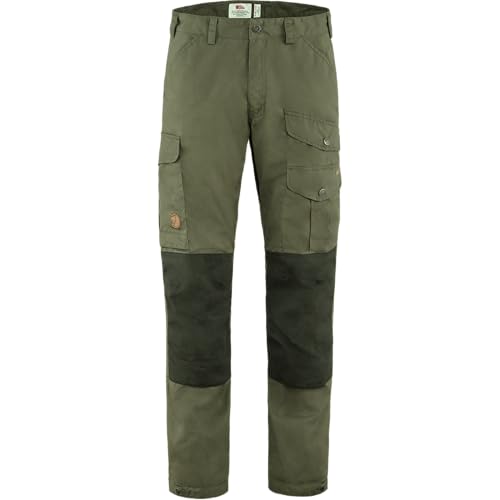
The fabric map explains the main difference
Fjällräven’s current standard Vidda Pro page lists G-1000 made from recycled polyester and organic cotton. It also describes reinforcement at the rear and knees. The listed main fabric does not include elastane, so a buyer should not expect its movement to feel like a highly elastic trouser simply because it is designed for trekking.
The current Keb page describes G-1000 panels combined with a separate stretch fabric. That mixed construction gives the garment a different design logic: reinforcement where it is wanted and stretch in other areas. The exact composition on a current page should not be assigned automatically to an older Amazon listing, but the panel-based distinction is central to identifying the right version.
When comparing two exact listings, look for the same model name and generation as the evidence you are reading. A familiar color combination does not prove fabric identity. If a product description says only Keb, confirm the selected version before relying on a particular recycled-content percentage or a review written about an earlier model.
Do the high-step check without using stretch to hide a size problem
With Vidda Pro, focus on the space available through the seat and thigh when the knee rises. Pre-shaped knees can assist the way the garment follows a bent leg, but the pant still needs enough room for your movement. If the waist fits while the thigh binds, a larger waist size may create a new problem without solving the cut mismatch neatly.
With Keb, notice whether the stretch sections move comfortably without pulling the waistband away from its intended position. Stretch can accommodate motion, but a pant under constant tension is not automatically the correct size. Load a normal pocket and repeat the movement to see whether the extra weight changes the fit.
Fjällräven’s current pages also describe updated or improved fits. Advice aimed at an existing customer changing from an earlier version should not become a universal instruction for everyone to size up. New buyers should use measurements and the exact chart; returning buyers should compare the model generation rather than trusting the size printed inside an old pair.
Ventilation is a feature you must be able to use
Keb’s current manufacturer description lists hip-to-knee ventilation zippers and additional calf ventilation. Standard Vidda Pro does not become the ventilated model merely because a retailer search returns Vidda Pro Ventilated alongside it. Those names identify separate choices, and the extra openings should remain attached to the appropriate one.
Think through how often you would open a vent. On a route with a cold start and a sustained climb, accessible ventilation can be useful. On an easy walk where you rarely adjust clothing, the same hardware may contribute little. The point is not that vents guarantee a cool wearer; they provide an adjustment that still depends on pace, weather and the rest of the outfit.
Check whether the openings are accessible beneath a long jacket or with the pack fastened. A useful feature on paper can become less convenient in the actual clothing combination. If vents are your main reason to buy, inspect the exact listing carefully enough to avoid ending up with the plain Vidda Pro when you intended the Ventilated version.
Choose pockets by the object, not by the count
Standard Vidda Pro’s current page lists six pockets, including map and multitool storage. Keb’s page describes hand pockets, two flap thigh pockets and an inner mesh pocket. These arrangements create different carrying options, but neither count establishes which will be more comfortable with your phone or other items.
Start with one object that you access repeatedly. Check whether it can be removed while the hipbelt is fastened and whether it sits across a joint when you kneel. Then consider a rarely used item, such as keys. A secure place that remains out of the way can be more useful than a larger pocket that encourages overloading.
Avoid turning reinforced fabric into a reason to carry every heavy object on the trousers. Pocket weight can pull at the waist and change how the leg swings. If the pack already provides a better location, leave the trouser pocket available for something lighter. The best layout is the one that supports your carrying habits without changing an otherwise comfortable fit.
Lower-leg details deserve their own fitting
The current Vidda Pro description includes cuff-strap adjustment and boot hooks. Keb also has a more elaborate lower-leg design, including the documented ventilation. Match the exact version’s hardware to the footwear you intend to wear rather than assuming one trouser works equally well with low shoes and bulkier boots.
Check the hem while standing, then bend the knee and place one foot on a step. The trouser should not force an unwanted tight ring around the boot or leave excess fabric beneath the heel. If the leg length is wrong, cuff adjustment can gather fabric but cannot necessarily make the whole lower leg sit correctly.
Both ranges can appear with short, regular and long designations. A numeric waist size paired with the wrong length is still the wrong listing. Write down the complete fit and inseam designation that you intend to buy. It is especially easy to lose that distinction when switching among color options or comparing European and US-facing size labels.
Wax only the fabric that is meant to receive it
Fjällräven describes G-1000 as wax-adaptable. That does not mean every panel on a mixed-fabric trouser should receive the same treatment. Keb combines materials, so follow the manufacturer’s instructions for the compatible panels and keep stretch sections out of an indiscriminate waxing routine.
Waxing is also not a conversion from hiking trousers into a fully waterproof rain shell. The decision concerns the behavior of a compatible fabric surface, while sustained wet-weather protection involves the complete garment construction. Keep that distinction clear when planning a rainy trip rather than assuming more wax eliminates every limitation.
For an owner who values simple care, standard Vidda Pro’s more uniform main-fabric description may be easier to understand. That is a maintenance preference, not proof of longer life. Keb can be entirely manageable when the owner follows panel-specific guidance. The right question is whether you are willing to maintain the exact garment as instructed, rather than whether a premium price makes care unimportant.
Challenge the two-model shortlist before committing
The shopping panel includes ATG Synthetic Utility as a separate lower-cost alternative. It is not another Vidda Pro specification or a budget version of Keb. It asks a useful question: does the planned walk require the particular construction that brought you to these Fjällräven models, or would a comfortable ordinary trail trouser cover the actual need?
Another option within Fjällräven is Abisko Lite Trekking, whose current page describes mapped G-1000 and stretch construction, hip-to-knee vents and reinforcement at the lower legs. Those details make it a relevant comparison for readers who want ventilation but do not automatically need the particular Keb arrangement. There is a dedicated Abisko Lite versus Keb guide for that decision.
Use the third option to challenge the original assumption, not to multiply products without a purpose. If your priority is moving comfort and you rarely need the standard Vidda Pro storage layout, it is reasonable to inspect Abisko Lite. If you specifically want the standard Vidda construction, an unrelated lighter-format alternative does not invalidate that preference.
Spend more only when the difference is useful
The budget label belongs to the separate ATG alternative, not to standard Vidda Pro. The purpose is to preserve a lower-cost route for readers who do not need the compared Fjällräven feature sets. Prices differ by size, color and seller. The observed listing position can guide an initial comparison, but the exact chosen variant decides the actual purchase cost.
Before paying more for Keb, name the feature that earns the difference: a stretch-panel fit you prefer, accessible vents you will use, or a lower-leg arrangement that suits the kit. If the answer is only that Keb is the higher-end name, the comparison is unfinished. Equally, buying Vidda Pro solely because it is cheaper is unhelpful if its moving fit does not work.
Neither choice carries a tested durability score in this guide. Reinforcement and construction are documented features; years of service depend on use, fit, care and wear that we have not measured. Choose the garment whose real design differences match your route and body, and let that decision remain separate from unverified lifetime claims.
Questions about fjällräven vidda pro vs keb: reinforced simplicity or stretch and vents
Does standard Vidda Pro have the same vents as Vidda Pro Ventilated?
No. The Ventilated suffix identifies a separate model. This comparison uses standard Vidda Pro, so the other model’s ventilation must not be copied into its description.
Can I wax Keb stretch panels like its G-1000 panels?
Follow the exact manufacturer instructions for each material. Mixed-fabric construction does not mean every panel should receive wax; avoid treating stretch areas as though they are G-1000.
Should every buyer size up for the improved Fjällräven fit?
No. Manufacturer advice for existing wearers changing versions is not a universal sizing rule. Compare measurements, the selected cut and the relevant chart.
Why is an ATG pant included in a Fjällräven comparison?
It gives readers a separately labelled lower-cost alternative when they do not require the exact Vidda Pro or Keb features. It is not treated as one of the two compared models or assigned their specifications.
Final Verdict
Standard Vidda Pro is the straightforward starting choice for a shopper who wants its reinforced G-1000 construction and pocket arrangement and obtains a good moving fit. Keb earns attention when its stretch sections and usable ventilation solve a specific problem. Keep the named versions separate, test the hem with the real footwear, and maintain compatible panels as instructed. If your concern is a lighter trekking format rather than this particular reinforcement-versus-stretch decision, compare Abisko Lite separately. None of these names turns a water-resistant trekking trouser into a waterproof rain shell.
Sources and further reading