Let the child help identify the problem
Ask the child to put the pants on with the underwear and shoes they expect to wear outside. Invite simple descriptions: pulls here, too scratchy, hard to fasten or keeps falling down. Those observations provide more useful information than asking only whether the pants look good or feel fine.
Have them sit on a chair, take an ordinary stair step and walk around the room. Use movements they already do comfortably; this is a clothing check, not a challenge to jump farther or climb higher. Watch for repeated waistband pulling, stepping on cuffs or a knee that cannot bend freely.
Check again after a few minutes rather than accepting the first answer during an exciting new-clothes moment. A stiff seam or closure may become noticeable once the child sits quietly. If a specific feature is bothering them indoors, there is little reason to expect a longer outing to make it less noticeable.
Keep the conversation concrete and neutral. A different size or model is a clothing choice, not a judgment about the child's body. The purpose is to find trousers they can move in and manage, rather than persuade them to tolerate a feature because adults consider it technical.
Use current measurements instead of age alone
Age ranges are convenient labels, but children of the same age can need different waist, hip and leg dimensions. Follow the exact youth chart for the model and record the measurements it requests. Do not substitute an adult chart from the same brand when the youth information is missing.
If the chart uses height, waist and hip measurements, compare each one rather than choosing solely from the age column. When they point to different sizes, assess which dimension needs room and how the waistband adjusts. A larger size may add length and rise that the child cannot use comfortably.
Measure a well-fitting existing pair as a reference if possible. Note the inseam, how the waistband adjusts and whether the child can pull it on independently. Label those as garment observations; they are not identical to the body dimensions in the manufacturer chart.
Check the selected size in the cart as carefully as the listing title. Youth products can combine age ranges, letters and numeric sizes, and a title showing several ages does not identify the selected option. The exact garment needs to match the measurement decision you made, not merely belong to the right broad age category.
Make growth room manageable today
Buying a little room for growth can be reasonable, but the pants still need to function on the next walk. The waistband should stay in place without severe cinching, and the crotch should not hang so low that it restricts a step. Extra length is useful only when it can be controlled without bulky folds or trailing hems.
Try any adjustable waistband in the position needed now. If it gathers a large amount of fabric under the front closure, check seated comfort and whether the child can still fasten it. An adjustment range is not proof that the largest possible size is the best value.
Folded cuffs may work on a simple leg for some uses, but inspect how they stay in place during walking. A cuff that repeatedly unfolds or holds a large bundle around the ankle is not a convincing everyday solution. Drawcords and tabs should be used and secured according to the garment's design rather than improvised into a major size correction.
Choose a fit the child can use now and revisit it as they grow. No purchase can guarantee a particular number of months of wear because growth, use and garment construction vary. An oversized pair that is continually adjusted can be less useful than a properly chosen current size.
Check closures as a small independent task
Ask the child to undo and refasten the main closure without coaching first, then help as needed. A button, snap, zipper and pull-on waistband require different actions. Consider the child's routine and how much assistance will actually be available at the trailhead or during a restroom stop.
For a drawcord, check whether the child can loosen it and whether the knot becomes difficult after tightening. A hidden cord may look tidy but still complicate dressing. A fixed waistband can be simpler once fastened, provided the size and rise are appropriate.
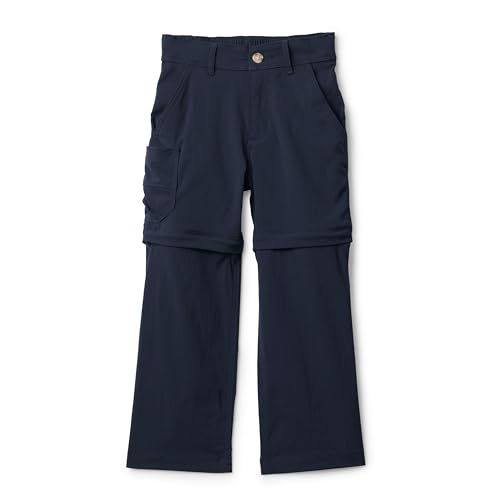
Convertible pants add another task. Let the child identify the leg zipper, open it and reconnect it with assistance appropriate to their ability. Decide whether that operation is useful enough for your outings to justify the extra seam and handling. Some families prefer changing before the walk; others value a convertible format during the day.
Do not treat independence as a pass-or-fail achievement for the child. It is information for choosing the garment. If the fastening is consistently frustrating, a simpler format may improve the experience more than adding another pocket or a more elaborate fabric claim.
Evaluate youth convertibles as two garments
Test convertible pants with the lower legs attached and removed. A pair can have a good full-length hem yet uncomfortable shorts because the zipper ring lands against the knee or upper leg. The child should sit and take a normal step in both configurations.
Look for twisting after the legs are reattached and check that the zipper is fully engaged as intended. If the pieces are not clearly identifiable, establish a simple storage routine so they remain together. The usefulness of removable legs depends partly on whether your family wants to manage those extra components.
The catalog includes Columbia Youth Boys Silver Ridge Utility Convertible Pant and Youth Girls Silver Ridge Utility Convertible Pant listings. Their youth identity and convertible format are established by those specific listings. The men's Silver Ridge Utility page does not establish their fabric composition, shorts length, rise or protective performance.
An ordinary nonconvertible option may be preferable if the child never wants to use the removable legs or dislikes the zipper seam. Choose the format that serves the planned outing rather than assuming a two-in-one garment is automatically better value. Simplicity is a legitimate feature when it makes the pants easier to wear and manage.
Compare pockets, fabric feel and actual trip needs
Put only the small items the child normally carries into the intended pockets. Ask them to sit and retrieve an item. A pocket that hangs low can swing against the knee; one with a difficult zipper may be useful for an adult holding valuables but less convenient for the child's own routine.
Feel inside the waistband and along seams for details the child has already identified as irritating. A product description cannot predict every wearer's response to a lining, label or seam finish. Choose based on the actual trial and avoid turning terms such as soft or breathable into comfort guarantees.
For a short local walk in mild conditions, a familiar pair that fits and permits movement may already serve the purpose. For a different weather forecast or a longer day, choose layers and clothing for those specific conditions rather than assuming anything titled hiking pants provides rain protection or insulation.
Amazon Essentials Boys' Water Repellent Regular Fit Active Hiking Outdoor Pants is a nonconvertible catalog comparison. Its water-repellent title should not be upgraded to waterproof. Marketplace youth listings sometimes use stronger claims without evidence available here; do not rely on those words as a substitute for understanding the garment and planning appropriate clothing for the outing.
Make the purchase decision and plan the next fit check
Compare the candidates using a short child-centered list: comfortable sitting, free ordinary step, stable waistband, clear hems, manageable closure and usable pockets. Ask which pair the child preferred and why. Their explanation may reveal a practical difference that was not obvious from the chart.
The budget, overall and premium examples on this page are shopping comparisons within the retrieved youth choices. Price position does not establish greater durability, better fit or superior performance for children. Choose the appropriate youth chart and department, and keep the FARVALUE age label, Amazon Essentials letter size and Columbia youth size tied to their own charts.
Before the first outing, review the garment's care label and keep the detachable components together if applicable. Recheck fit after a noticeable growth change or when the child begins pulling at the waistband, stepping on cuffs or avoiding a previously comfortable pair. Those changes are reasons to inspect the clothing rather than assume unwillingness to wear it.
If a plain hem alteration seems useful, have its feasibility assessed and keep the original movement checks in mind. The alteration guide explains construction limits. The best youth choice remains the garment that functions comfortably for the child now, with only the manageable room needed for the next stage of use.
Questions about choosing hiking pants for children: fit, growth and usable features
Should I buy children’s hiking pants a full size larger for growth?
Not automatically. Try the larger size only if the waistband remains stable, the rise permits a normal step and the hems can be controlled comfortably. Growth room should not make the garment difficult to wear on the next outing.
Can I use the adult Silver Ridge specifications for a youth pair?
No. Match the youth model’s own label and product information. A shared family name does not establish identical fabric, shorts length, sizing or features across adult and youth garments.
Are zip-off hiking pants worth it for a child who cannot reconnect the legs?
They may still work with adult assistance, but decide whether your routine benefits from the extra components. If the child dislikes the zipper ring or the legs will rarely be removed, a simpler pant can be the more useful choice.
Does a water-repellent youth-pants listing mean rain pants are unnecessary?
No. Water-repellent wording does not establish a waterproof barrier or sealed seams. Choose clothing for the actual conditions using verified garment information rather than treating the hiking-pants label as complete weather protection.
Final Verdict
Let current fit and the child's practical experience lead the decision. Confirm the exact youth chart, check both seated comfort and stepping, and make sure the closures and pockets are usable in your family's routine. Leave only growth room that the garment can manage comfortably today. FARVALUE and Columbia youth convertibles plus a simpler Amazon Essentials option provide different formats to compare, with no reason to transfer adult specifications or assume a higher price fits better. The most useful purchase is a pair the child can move in, wear willingly and manage with the level of assistance the outing realistically provides.
Sources and further reading