
Columbia Women's Leslie Falls II Stretch Pants
Snap-cuff example with a primary-source description to examine alongside your footwear.
Consider: Structured waist and active cut may not suit every wearer.
Check on Amazonconstruction
The bottom few inches of a trouser leg can decide whether a pair works with your footwear. A neat elastic cuff may sit comfortably above one shoe and pull awkwardly against a taller boot. A straight hem may drape cleanly when standing, then catch under the heel when walking. Examine the opening as a moving connection between trousers, socks and footwear, rather than choosing only the silhouette you like.
Three places to start
As an Amazon Associate I earn from qualifying purchases. Purchases take place on Amazon.
Snap-cuff example with a primary-source description to examine alongside your footwear.
Consider: Structured waist and active cut may not suit every wearer.
Check on Amazon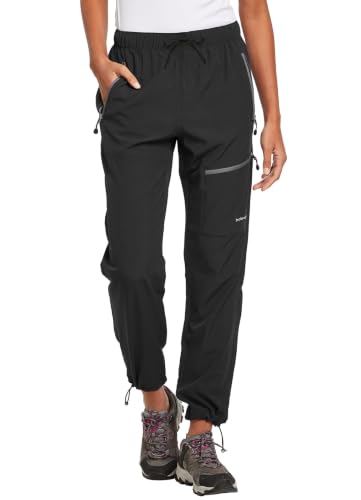
Lower-priced gathered-ankle option for testing a jogger silhouette.
Consider: Different BALEAF lengths and pocket versions must be distinguished.
Check on Amazon
Higher-priced trail jogger listing to compare with a straight hem.
Consider: Do not borrow fixed-leg Ferrosi fit or cuff claims.
Check on AmazonEditorial selections from the products considered for this guide; not hands-on test awards. Budget and premium describe positioning, not a guaranteed current price.
A tapered leg narrows toward the ankle, but it need not have elastic. A jogger commonly combines taper with a gathered cuff, while some hiking pants use a drawcord, snap or strap on an otherwise open hem. These details affect how the fabric moves and how easily it passes over footwear. A photograph of a narrow silhouette does not identify the mechanism.
Read the selected model's description and inspect close-up images before assuming you can loosen the opening. A permanently elastic cuff has a limited stretch range. A drawcord may enlarge the opening only to the circumference of the surrounding fabric. A snap adjustment offers discrete positions, not unlimited flexibility. If the opening cannot accommodate your use, forcing the fastening is not a fitting solution.
This article concerns the lower-leg interface, not whether ordinary athletic joggers are suitable hiking garments. Fabric, pocket security and overall cut remain separate decisions. You can prefer a jogger cuff on a trail-specific design while rejecting a heavy fleece lounge pant for the same outing. Keep the closure question distinct from the garment category.
Check whether the advertised length is measured to the bottom of a gathered cuff or to a conventional hem, and use the manufacturer's stated method when available. The visual impression of exposed ankle is not a measurement. A jogger's elastic can hold the end above its fully extended position, so compare both the listed inseam and the location where the garment naturally settles during wear.
Bring the trail shoes or boots into the fitting check. Put on the socks you expect to use and fasten the footwear normally. Let the pant leg settle without arranging it for a flattering photograph. Notice whether the cuff rests above the collar, surrounds it or falls over the upper. None of those positions is automatically correct for every design.
A gathered cuff that rests above a low shoe may leave a gap when the knee rises. Over a taller boot, the same opening can gather into a tight band or remain perched on the collar. A straight hem may accommodate that boot more easily but be too broad around a low shoe. The practical choice depends on which combination you use most often.
Do not judge compatibility by forcing a cuff down and expecting it to stay there. Walk, climb a familiar step and sit. If the hem repeatedly moves to a different resting point, evaluate that actual position. A garment should work during ordinary movement without constant pulling at the ankle. Our length guide addresses the separate question of usable inseam.
Lift one foot onto a low, stable step while keeping the other on the floor. The knee bend draws fabric upward, and the hem may rise with it. In a gathered design, the ankle grip can keep the cuff in place while fabric above it stretches or bunches. In a straight leg, the opening may slide more freely over the shoe.
Feel where the tension travels. Pressure at the cuff is different from a tight calf or an insufficiently roomy knee. If the leg cannot rise comfortably, loosening the ankle adjustment may reveal whether the closure is involved. If nothing changes, the restriction may come from higher in the garment. Avoid blaming the hem for a rise or thigh problem that requires another cut.
Repeat the movement after a few minutes of walking, when the garment has settled. A cuff that initially sits perfectly may rotate, and a loose drawcord tail may migrate toward the shoe. Secure adjustment parts only in the way the manufacturer intends. Do not improvise knots or routing that could damage the component or create a new snag point.
The main appeal of a gathered opening is that it controls excess cloth. This can be pleasant around a low shoe and may keep the hem from dragging. The tradeoff is contact around the ankle or lower calf. The elastic should not have to be stretched near its apparent limit simply to reach a comfortable resting position.
A straight opening distributes contact differently. It can drape over a boot and may feel less constraining when seated, but extra circumference can fold under the heel or brush the opposite leg if length and cut are poorly matched. A slightly shorter or differently shaped garment may solve that issue more cleanly than tightening an improvised ankle band.
Adjustable hems occupy a middle ground when the mechanism offers enough range. They can narrow an opening for one activity and relax it for another, but more adjustability also means more components to inspect and operate. Choose the setting you can use comfortably without excessive gathered fabric. An adjustment is a tool for refinement, not proof that the same hem fits all footwear.
A closer opening reduces the visible gap at the trouser end, but normal hiking pants are not sealed systems. Material, seams and other openings remain, and a cuff can move during walking. Do not describe an elastic ankle as insect-proof, water-tight or protective equipment. If you need a specific form of protection, look for appropriate independent guidance and the relevant equipment rather than inferring it from a fashion detail.
For ordinary debris management, assess the whole shoe-and-leg arrangement. A cuff perched high above the collar may leave an opening even when its elastic is snug. A broad hem over a shoe may cover the collar but move away while stepping. A compatible gaiter may be worth evaluating for your conditions, with the understanding that its own fit and design matter.
Rain is another separate issue. Tightening a water-repellent pant's cuff cannot make the garment waterproof. A rain layer needs to work as a complete system, including its relationship with footwear and any gaiter. Keep that weather-layer decision separate from choosing the everyday trouser opening you find most comfortable.
Outdoor Research Ferrosi Jogger listings provide a distinct alternative to the fixed-leg Ferrosi Pant. The shared family name does not mean every fabric, pocket or hem detail is identical. Examine the jogger listing itself and confirm the features important to your footwear. A model title establishes the format more reliably than it establishes the amount of ankle stretch.
Columbia's current Women's Leslie Falls Pants II has snap cuffs, along with a structured waist and articulated knees. The separate Leslie Falls Pull-On has different published inseams and waist construction. Those distinctions illustrate why the exact model matters: choosing a pull-on waist does not prove the ankle behaves like the snap-cuff design.
The North Face's current Men's Paramount Pro describes drawcord hems. Its plain Paramount and its convertible variants need their own checks. BALEAF offers several jogger and drawstring-hem listings at lower captured prices, but those listings are not interchangeable with one another. Compare the opening, selected length and calf room rather than assigning all products from one brand the same cuff behavior.
If a hem drags, first check whether you selected the appropriate inseam and whether the waistband is sitting where the garment was designed to sit. A low, slipping waist can create extra length at the shoe. Tightening the ankle may conceal the symptom while leaving the main fit problem untouched. A different length or rise can be a better correction.
If the cuff feels tight, distinguish permanent elastic from a closure that is simply over-adjusted. Relax an adjustable system and repeat the movement check. If a fixed cuff remains uncomfortable, another opening shape is more promising than hoping the elastic will stretch into an ideal size. Alteration may be possible, but a tailor needs to evaluate the construction and any effect on the garment.
Finally, test the combination with a gaiter only if you intend to use one. Avoid stacking a large rolled cuff, an elastic band and a tight gaiter closure at the same point. Each component may be comfortable alone yet create pressure when layered. The cleanest arrangement uses only the adjustment needed for the actual footwear and conditions.
Possibly, but the cuff must settle comfortably around or above the boot without pulling the leg or forming a bulky band. Bring the boots to the fitting check. A jogger label alone does not establish boot compatibility.
No. Use only the adjustment needed for a comfortable, controlled opening. Excess tightening can bunch fabric and create pressure. Keep the cord and toggle arranged as designed so they do not hang near the sole or other moving gear.
It may keep the very end from dragging, but excess leg fabric can still bunch and knee shaping may sit incorrectly. Choose an appropriate length and cut first; treat cuff control as a finishing adjustment.
Select the ankle opening with your footwear on and your knees moving. Jogger cuffs offer a tidy gathered finish, straight hems provide a different kind of clearance, and adjustable designs let you refine a workable fit. None rescues an unsuitable inseam or a restrictive leg. Keep the hem clear of the sole, avoid pressure from stacked layers and verify the exact model's mechanism. The right cuff is the one you stop noticing once you start walking, while still giving the coverage and footwear interface you intended.